


Homeownership is a pipe dream for most Torontonians.
Less than one in six people in our city can afford to buy a home here. For the few who do, the hurdles don’t stop once you get your keys. That’s why, our team created this tool to help homeowners navigate their options, from energy and garden programs to cohousing and co-ownership opportunities.
We compiled all the helpful resources you can access from the City of Toronto, Province of Ontario, non-governmental organizations and The Green Line’s own handy guides.
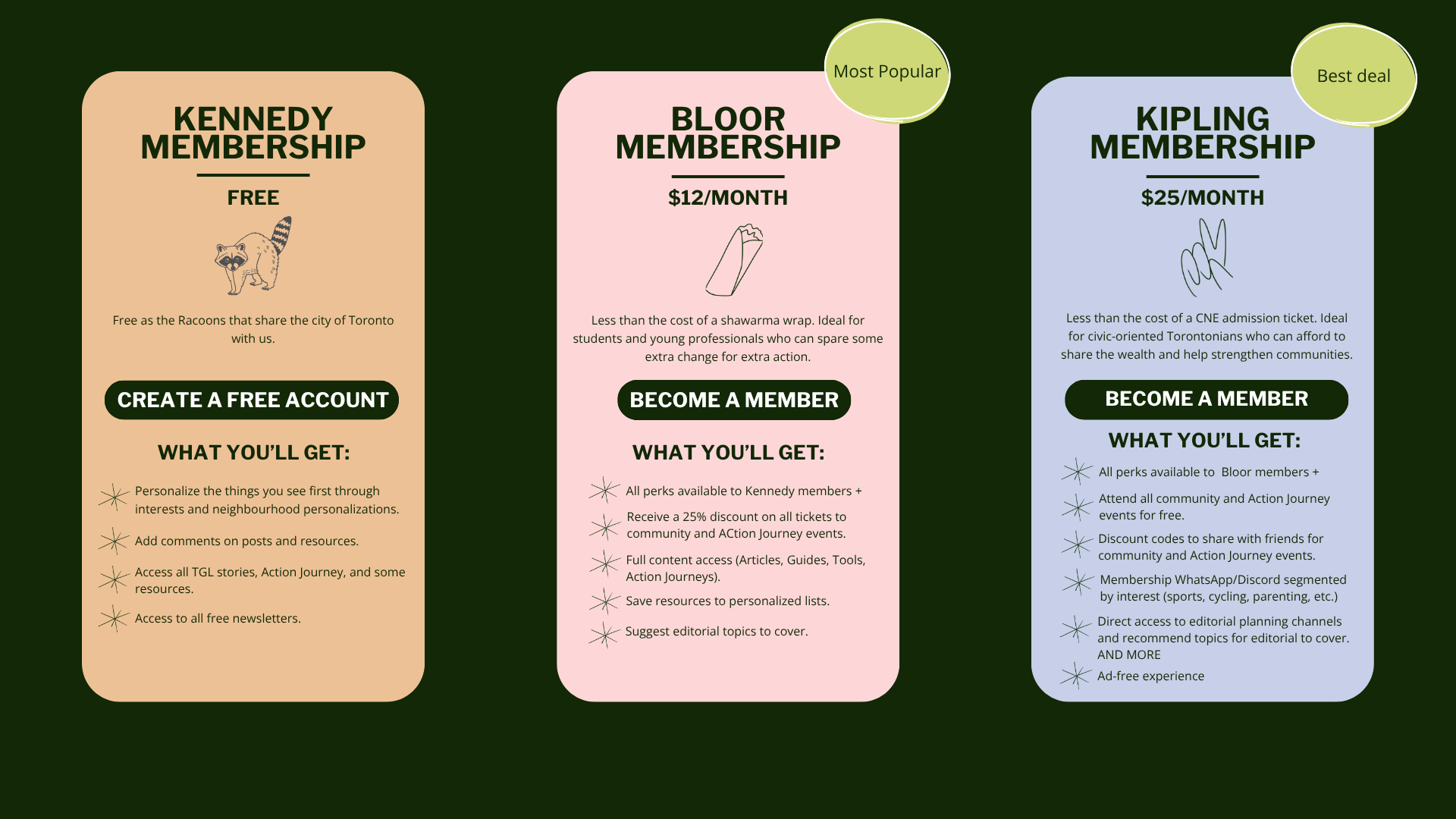
BECOME A GREEN LINE MEMBER TODAY
First, check out the list, below, of everything you need to be aware of; then, scroll down for a detailed explanation on how to use each resource. If you’d like to explore how each resource listed can help you, just click it to go directly to the explanation.
Subsidies and rebates
- Better Homes Toronto’s green energy programs
- Ontario’s Home Renovation Savings program
- Rebates and tax deductions for low-income seniors and people with disabilities
Guides for owners
- Condo owners’ guide, by the Condo Authority of Ontario
- Home and garden inspo and info, by the Toronto and Region Conservation Authority
- Home builders key terms, directory and complaint process, by the Home Construction Regulatory Authority
- Tools for managing your mortgage and aging in place, by Canada Housing and Mortgage Corporations
- Handbook for carrying out major renovations, by Toronto’s Committee of Adjustment
Non-governmental organizations
TGL resources:
If you’re interested in exploring co-housing or co-ownership, or need help with utility bills, check out these step-by-step guides from The Green Line team.
- How to buy a house with co-owners
- The Green Line‘s guide to co-housing in Toronto
- Need help paying utility bills? Check these grants for Torontonians
Better Homes Toronto green energy programs
The City of Toronto has multiple ways to help homeowners renovate and upgrade their homes to get to net zero. Collectively, the programs are referred to as Better Homes Toronto, which includes the following.
- Home Energy Loan Program
- Furnace Upgrade Program
- Basement Flooding Protection Subsidy Program
- Eco-Roof Incentive Program
- Other incentives and rebates to green your home
1. Home Energy Loan Program
Through the Home Energy Loan Program (HELP), you can borrow up to $125,000 at a low interest (ranging from 3.46% to 4.86% over five to 20 years, respectively) to cover the cost of home energy improvements, such as:
- Air-source heat pumps
- Window and door replacements
- Insulation, including basement, attic, exterior wall
- Air sealing, such as weather stripping or caulking
- Geothermal systems
- High-efficiency water heaters
- High-efficiency furnaces, boilers, air conditioners
- Tankless water heaters
- Drain-water heat recovery systems
- Toilet replacements
- Solar hot water systems
- Rooftop solar PV panels
- Electric vehicle charging stations
- Battery storage
You can apply to the program online through this form. The application and approval process can take up to 41 days, and includes a home energy assessment with an advisor registered by Natural Resources Canada. To qualify, you must:
- own a detached, semi-detached or row house, or a unit in a multiplex or any low-rise residential building,,
- have consent to participate from all of the property owners,
- not have been late to pay property taxes or utility bills 60 days past their due date three times in the last three years,
- and obtain written consent from your mortgage lender if applicable.
You can learn more on the City of Toronto’s HELP page.
2. Furnace Upgrade Program
The Furnace Upgrade Program helps homeowners replace aging furnaces with electric heat pumps.
- To start the process, request a free appointment with a Toronto Hydro energy expert by filling out this form and emailing it to energycoach@torontohydro.com.
- If you book an appointment before July 31, you’ll have a chance to enter a contest to win $5,000 towards upgrading your old furnace to an energy‑efficient heat pump.
3. Basement Flooding Protection Subsidy Program
Owners of a single-family, duplex, triplex or fourplex residential home can apply online for a subsidy to help protect their property from basement flooding.
The city offers up to $6,650 in subsidies per property for work completed on or after Nov. 12, 2025, including:
- up to $500 for a home plumbing assessment,
- a maximum of $1,600 each for two backwater valves and alarms,
- a maximum of $2,250 for a sump pump or alarm, plus up to $300 for battery backup power
- and up to $400 to help offset the cost of disconnecting foundation drains, a.k.a. weeping tiles, from the city’s sewer system by severing and capping the underground sewer connection.
4. Eco-Roof Incentive Program
Through the Eco-Roof Incentive Program, the City of Toronto offers home and building owners the following.
- $100 per square metre (up to a maximum of $100,000) for green roof projects, which is planting vegetation on top of your roof,
- $2 to $5 per square metre (up to a maximum of $50,000) for cool roof projects, which are roofing systems with an exterior surface that reflects the sun’s rays and reduces heat build-up from the sun’s thermal energy.
- You can apply here before you start working on your roof.
For step-by-step instructions and more information, check out the Eco-Roof Incentive Program page.
5. Other incentives and rebates to green your home
The City of Toronto has a table that lists all low-interest loans and rebates for green projects. Check it out here.
Ontario’s Home Renovation Savings™ program
Ontario’s Home Renovation Savings™ program offers rebates to homeowners to encourage them to improve their home’s energy efficiency. You can apply to one or multiple of the program’s “bundles” to get money back on completed energy efficiency projects.
In general, to qualify, you must:
- own your home in Ontario, which can be a detached, semi-detached or row house, or a townhouse (except stacked townhouses).
- be an Enbridge Gas customer with an active account, and primarily heat your home with a natural gas furnace or boiler, or
- be connected to the Ontario electricity grid, and heat and cool your home with electricity.
Here’s a breakdown of rebates available:
- You can get $100 for a new smart thermostat.
- If you haven’t bought one yet, you can apply to get a discount code for a value of $100, usable online and in-store at Home Depot, or online at Best Buy, Copeland Sensi or ecobee.
- If you already bought an eligible smart thermostat, you can apply for a $100 rebate here.
- You can also get money for replacing old appliances with energy-efficient ones from a set list. Items you can apply for include:
- $200 for a heat pump clothes dryer
- $75 for a washing machine
- $150 for induction cooktops and ranges
- $25 for a dishwasher
- $50 for a fridge
- $50 for a freezer
To qualify, you have to have an existing appliance in need of replacing, and you must submit your rebate application within 60 days of buying a new appliance.
- You can get up to $5,000 for installing solar panels and up to $5,000 for battery energy storage
- Confirm your eligibility using this form.
- Then hire a contractor, who you can choose from the Canadian Renewable Energy Association’s Go Solar Guide.
- Once you receive written pre-approval from the Home Renovation Savings team, you can go ahead and install your solar panel system.
- To receive your cheque, the contractor needs to submit required documentation. Check out this post-installation checklist for the details.
- If you work with a participating contractor to insulate your attic, cathedral ceiling or flat roof, you can get rebates up to $1,250, depending on the type of roof you have.
- Complete this form to confirm your eligibility, and receive a list of participating contractors.
- To qualify for the rebate, 100% of the total area of your roof assembly must be insulated.
- After your contractor submits all required documentation, you’ll receive your rebate by cheque.
- You can get up to $3,000 back for upgrading your home’s heating and cooling system with a heat pump.
- If you get an assessment by a registered energy advisor, then complete at least two eligible upgrades, you can receive $600 plus specified amounts for each upgrade, including:
- Up to $1,500 for attic insulation
- Up to $2,300 for foundation insulation
- $300 for exposed floor insulation
- Up to $3,600 for exterior wall insulation
- Up to $250 for air sealing
- $500 for heat pump water heaters
- $100 per door/window
If you complete three or more upgrades, you can get an additional $500. Once you complete the upgrades, your energy advisor has to submit a report. Then your cheque should arrive by mail within 60 days. Apply on this page.
Rebates and tax deductions for low-income seniors and people with disabilities
The City of Toronto has several programs to lower the property tax, water bill and garbage fees for low-income seniors and people with disabilities. They all fall under the Property Tax, Water and Solid Waste Relief program.
- The programs are:
- Property Tax Increase Cancellation Program, where the City of Toronto cancels the amount by which your property taxes increased over the previous year.
- Property Tax Increase Deferral Program, where the City of Toronto allows you to delay paying the amount by which your property taxes increased over the previous year.
- Water Rebate Program, where the city applies a rebate – essentially, a partial refund or credit – to the water consumption portion of your utility bill.
- Solid Waste Rebate Program, where the city applies a rebate – essentially, a partial refund or credit – to your garbage collection fees.
- You have to apply to each program every year in the spring. The deadline this year is Nov. 20, 2026, but the application hasn’t opened yet.
- You can apply through the following ways:
- Online through a form to be shared by the City on this page
- By fax to 416-696-3605
- By mail to “City of Toronto, Revenue Services, General Correspondence – 5100 Yonge St., Toronto, ON M2N 5V7”
- In person at an Inquiry and Payment Counter
- Each program has its own set of eligibility criteria and documents required, as listed on the City of Toronto’s program page. Generally, to qualify, the total income of your household should be less than $62,000 per year, and you should either receive disability benefits, be over 65 or meet other requirements if you’re between 50 and 64.
Condo owners’ guide
The Condominium Authority of Ontario (CAO) is an organization that was designated by the Government of Ontario to provide services and resources for condo communities. It’s funded by fees paid by condo corporations.
The CAO Condo Owners’ Guide is an exhaustive document that can provide condo owners information about their rights, responsibilities and finance essentials. It also breaks down how condo corporations work, who’s responsible for what repairs, and how corporations, owners and tenants can resolve disputes at the Condo Authority Tribunal. The guide also includes checklists for first-time owners and emergencies.
Home and garden inspo and info
The Toronto and Region Conservation Authority (TRCA) has multiple downloadable guides to help you manage rainwater in your home, grow non-invasive plants, and explore lawncare and naturescaping. You can find a list of all these guides and more here.
TRCA also hosts events where you can enjoy the great outdoors, or learn how to bring nature to your own home, like in this workshop on supporting pollinators.
Home builder key terms, directory and complaint process
The Home Construction Regulatory Authority (HCRA) licenses and regulates the people and companies who build and sell homes in Ontario. It also provides educational resources, deals with complaints about builders and maintains a directory of licensed professionals.
Here are some useful resources for homeowners:
- Consumer Education and Resource Hub is a series of blog posts and recorded webinars breaking down important information on everything homeowners should do, from dealing with noisy neighbours to taking fire safety precautions.
- Ontario Builder Directory provides information on a builder’s licensing status, years of activity, number of homes built, plus any regulatory actions (i.e. concerns, charges or convictions) taken by the HCRA against the builder.
- Builder/Seller Complaint Form is a form you can fill out if you have concerns about the conduct or competency of a home builder or seller.
- Key Terms Ontario Homebuyers Should Know
Tools for managing your mortgage and aging in place
Canada Housing and Mortgage Corporation or CMHC provides research, data and insights on how to finance housing for owners and buyers in Canada. It also delivers our country’s housing program. Here’s what CMHC can offer you:
- Tips and advice to manage your mortgage, including what to do if you can’t pay and how to avoid fraud.
- Resources for seniors to prevent fraud, refinance their homes and more.
- Tips on finding a contractor to do work on your home.
Handbook for carrying out major renovations
If you’re planning to do major renovation or additions to your home, sketching up your dream design isn’t enough. Depending on the type of work you’re planning, you might have to go through the City of Toronto’s Committee of Adjustment to get approval and permits. The good news is the City has a handbook that breaks down everything you need to know.
- If your design is fully compliant with the City’s zoning bylaws, you might not need to go through the committee.
- Common scenarios that require approval from the Committee of Adjustment include:
- Reducing side or back yard setbacks
- Increasing the building height
- Parking or driveway layout issues
- Changes to heritage buildings
- There are several types of applications processed by the committee:
- Minor variance, which is what you need if you’re asking for an exemption from a specific zoning requirement
- Consent, which is generally used for projects that involve severing land or adjusting lot lines
- Tree declaration form, which is about the impact on trees on your property
- You can use this application checklist to get started; it includes forms and fees and.
If you want to dive into the details and learn more, check out the Committee of Adjustment Participation Handbook.
Landlord’s Self-Help Centre
The Landlord’s Self-Help Centre (LSHC) is a non-profit community legal clinic funded by Legal Aid Ontario and specialized in supporting Ontario’s small landlord community.
- It provides general information, advice and referrals for legal issues related to landlords’ rights and responsibilities in residential tenancies.
- LSHC has learning modules, which are step-by-step video guides to help landlords correctly complete forms required under the Residential Tenancies Act.
- It offers bilingual factsheets about different common scenarios, including subleases, selling a rental unit, sharing a kitchen and/or bath with tenants and more.
- Contact LSHC by phone at 416-504-5190, toll free at 1-800-730-3218 and by email at info@landlordselfhelp.com.
Learn more about available resources on LSHC’s website.
The Housing Help Centre
The Housing Help Centre (THHC) is a non-profit agency that helps people access and maintain affordable and safe market rent accommodation.
- If you’re a landlord who has properties available to rent, THHC can match you with potential tenants.
- Staff will visit your units to learn about your preferences for tenants, and to learn more about what utilities and amenities you have available.
- This information goes into a database of available properties in the City of Toronto and York Region.
- THHC’s main office is in Scarborough, and the team can be contacted by phone at 416-285-8070.
Learn more on THHC’s website.


Join the conversation