


These meeting notes are part of Documenters Canada, which is partly funded by the Social Sciences and Humanities Research Council of Canada (SSHRC). Learn more about our program here. The Green Line maintains full editorial independence to ensure journalistic integrity.
Toronto is moving forward with two major initiatives improving community well-being through recreation and mental health support.
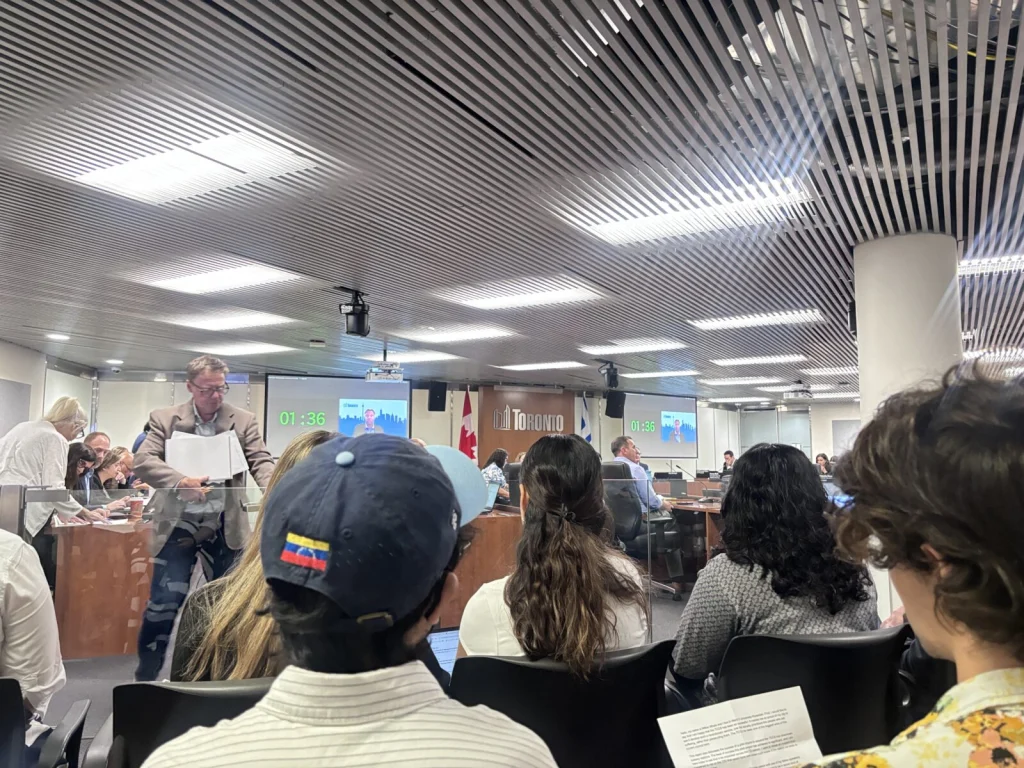
At a Toronto Executive Committee meeting on July 21, 2026, the Cit reviewed a long-term lease agreement for the Toronto Tempo’s future practice facility at Exhibition Place and supported the expansion of the Toronto Community Crisis Service (TCCS).
Many deputants came out to speak for both items — in favour of the development at Exhibition Place and happy about the non-police emergency response for people experiencing mental health crises.
Toronto Tempo brings community space at Exhibition Place
The first item focused on a rezoning for 701 Fleet St. that was approved on July 8, 2026. The site is an Exhibition Place parking lot that was designated as parkland that the City of Toronto didn’t have the funding to build.
Toronto Tempo has made a deal with the City to privately finance a 60,000-square-foot practice facility in exchange for a 40-year lease — which also includes building the public park at no cost to the city.
Documenter Dorsa Farzi said the Toronto Tempo discussion felt like a celebration, with everyone in favour of the property plan. Many people said they were happy, because it meant more investment in girls and young women in sports, immigrants and newcomers and even Toronto’s identity.
Teresa Resch, the team’s president, said that Toronto Tempo has sold out each game in its inaugural season at Coca-Cola Coliseum. They said this deal secures over 2,260 hours of guaranteed community access a year. The long-awaited park would also be built a decade sooner than planned.
Deputy Mayor Ausma Malik asked Resch a number of logistical questions regarding the development. She asked how the community access hours in this deal compared to other city facilities, like the Ontario Tennis Association.
Resch said the deal with Toronto Tempo offers more hours in comparison and operates year-round.
Mayor Olivia Chow said this was the first time she clapped as Chair, after hearing Resch’s presentation. She shared a personal story about immigrating to Canada and finding belonging through basketball.
Malik moved a motion to protect Exhibition Place’s continued use for events like the Canadian National Exhibition (CNE), to find replacement parking where needed and to push for community engagement.
Her motion was carried.
Toronto Community Crisis Service expansion
The committee also checked in about the Toronto Community Crisis Service (TCCS) and discussed its expansion.
The initiative launched in 2022 as a 24/7, non-police emergency response to mental health crises. It’s been piloted on Line 1 for the last year. The Executive Committee met to review its impact and plan the next five years.
Over the lifespan of the project, nearly 50,000 calls have been answered so far.
Many deputants were in favour of this initiative, showing support for the expansion of the service.
Fouad Agha, a Toronto Metropolitan University student and a University-Rosedale resident, said that Line 1 stations “feel noticeable calmer and safer — way safer than a few years ago.”
They said they watched someone in crisis on the streetcar a few years back, with no one knowing what to do. They said everyone on board was negatively impacted. In their deputation, they asked for the service to come to busy stations like Kennedy and Kipling, and onto streetcars.
Agha also suggested faster response on the SafeTTC app and more advertising on the service.
Wilkie Whale, another Toronto resident, said the service is “one of the biggest wins of this current council term.”
Many other deputants shared similar sentiments and spoke about the importance of 211 as a hotline.
Chow asked for staff to research and report back by the first quarter of 2027 on expanding the service to all stations, building on Line 1’s success.
Documenter's POV
I was in Toronto when the Raptors won their championship in 2019, and I saw firsthand how much the city rallied around that moment. People from every neighbourhood celebrated together. It reinforced for me how much professional sports can mean to this city.
As a woman documenting this meeting, I also found it meaningful to watch a women’s team draw sold-out crowds in its first season and to hear councillors speak directly to what that visibility means for girls growing up in Toronto.
Beyond the team itself, the added community programming and public park space addresses the city’s shortage of quality recreational space.
I also take the TTC multiple times a week myself, so the discussion around TCCS hit close to home. In early 2023, at Yonge and Finch station, in a quiet part of it around 8 a.m., I saw a man yelling that he wanted to harm himself while wielding a knife. Another rider who was nearby reported the behavior to a TTC employee. The distressed person started chasing the other rider down the platform. Armed police showed up a few minutes later and arrested him. It took a long time for anything to actually happen, and by the end of it, it was pretty clear to me the person didn’t get the help he needed, just handcuffs.
Even though this incident was the scariest in my experience, it’s not isolated. There were many instances of someone yelling, someone clearly distressed but not armed or chasing anyone, where I’ve felt genuinely stuck. Once I saw a person whose legs were purple, looking like they were about to fall off from frostbite, walking around yelling at people. I’ve seen that plenty of times outside the U-zone, outside the downtown core, and every time it’s the same feeling: not knowing if reporting it gets the person actual help or just gets them arrested, hurt, or kicked back out into the cold with nothing solved.
That’s exactly the space some deputants were describing, situations where calling 911 felt like the wrong move, but there wasn’t an obvious right one either. I didn’t even know 211 was an option until this meeting. That’s why the questions about expanding TCCS, and about who decides, police or TCCS, when a call comes in, matter.
If you witness someone in distress on the TTC, you can call 211 to speak with the Toronto Community Crisis Service (TCCS). In the case of an emergency, call 911.
Fact-Check Yourself
Sources and
further reading
Don’t take our word for it — check our sources for yourself.

Join the conversation