
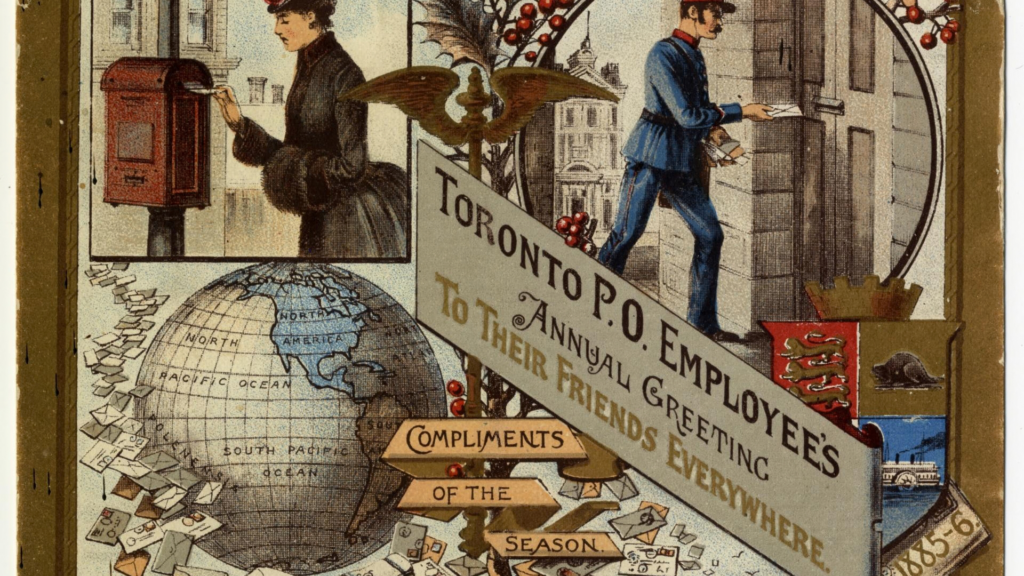

At some point in your life, you’ve probably visited a Canada Post office in Toronto, whether to return an Amazon purchase or to mail a birthday card to your grandmother.
It wasn’t always easy to find a post office or mail items internationally (some say it still isn’t) — back in the late 1700s to mid 1800s, post offices were scarce and their services were expensive.
Garfield Portch, a philatelic (the study, collection and appreciation of postage stamps and postal history) expert and executive director of the Vincent Graves Greene Philatelic Foundation, spoke with The Green Line about the postal service history in Toronto. His research follows the time period from 1793 through the development of Toronto’s postal service to Queen Victoria’s death in 1901.
BECOME A GREEN LINE MEMBER TODAY
William Willcocks was the first postmaster in York, holding the role from 1979 to 1801; he was succeeded by William Allen.
On March 6, 1834, the city of York became Toronto. This change caused the fourth post office in the community to be called Toronto’s first post office, which is still open at 260 Adelaide St. E.
There was no mail delivery back then; residents visited the post office to collect their letters. Addresses would be as simple as “John Smith, York” because street names and house numbers were unnecessary.
Portch described the post office as a social hub. “The postmaster knew everybody and probably everybody’s business,” he said.
The post office was open seven days a week because people would travel far to reach it. For example, farmers travelling into York would stop at the post office on their way to church, Portch said.
During this period, communication was difficult; there were no railways connecting Toronto and Montreal and no modern highways. Portch explained how one courier would make the journey a quarterly walk between the two cities in a year, travelling “on foot or by horseback.”
If you think stamps are expensive now, postal rates back then were also expensive. A single-sheet letter travelling up to 60 miles (about Toronto to Kitchener) cost four and a half pence, which was a significant amount at the time. For comparison, milk cost three and a half pence per quart or three pence per dozen eggs.
There were no postage stamps during this time period either. “All of the postage that we see in Upper Canada is manuscript postage,” Portch explained. The amount was written directly on the letter. International letters could involve Canadian, United States and United Kingdom currencies, depending on the route.
In 1851, Canada had its first stamps. There were three: the three pence stamp featured a beaver, the six pence stamp featured Prince Albert and the 12 pence stamp featured Queen Victoria. The Queen Victoria stamp is one of the most valuable stamps in Canada. Some of the stamps go for thousands of dollars on the market.
When the railway between Montreal and Toronto was built in 1856, it changed the postal system. Portch said, “a letter mailed in Toronto today had better be delivered in Montreal tomorrow.”
Any mail that arrived at the post office after the early evening cutoff time received a handstamp, “too late,” so the person receiving the letter would know the delay was on the sender, not the post office.
As Toronto grew, more branches opened. “There was only one post office in Toronto until 1880,” Portch said. That year the city saw three new branch offices, east, west and north. More locations opened on Elm Street, York Street, Peter Street and Church Street.
These changes were part of a larger transformation of the city, Portch said. “The post office exploded because the population of Toronto was exploding.”
Did we spark your interest in Toronto’s postal history? Let us know if you’d like to learn more by sending an email to julia@thegreenline.to or by leaving a comment on this page.
Fact-Check Yourself
Sources and
further reading
Don’t take our word for it — check our sources for yourself.


Join the conversation