
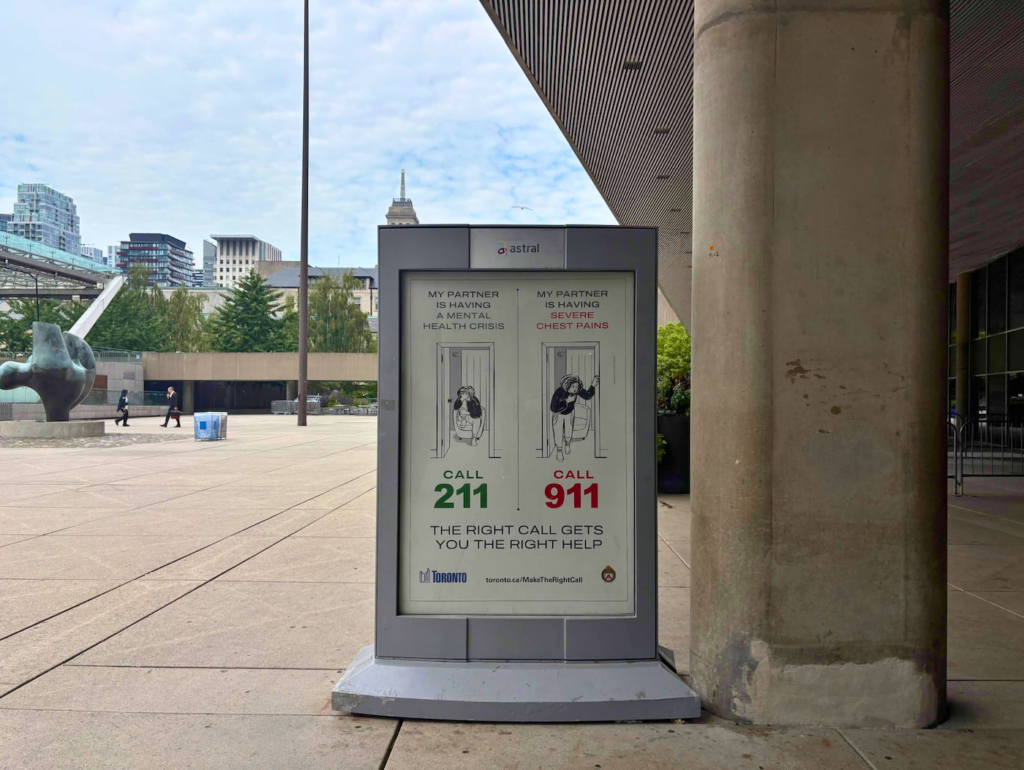

When you learn about emergency numbers to memorize, you start with 911.
But 911 isn’t the best option for every emergency.
If someone’s having a mental health crisis on the subway, I personally wouldn’t want police officers coming down on them. A lot of Torontonians agree and have praised the Toronto Community Crisis Service pilot on Line 1, which allows people to call 211 for non-police emergency help. It frees up 911 for life-threatening issues and gets better response times for people in need.
BECOME A GREEN LINE MEMBER TODAY
Wilkie Whale, a resident who attended the Toronto Executive Committee meeting on July 21, 2026, as noted by a Documenter, said the service is “one of the biggest wins of this current council term.”
Whale isn’t the only person we’ve heard praise 211 this year.
Ed Brown, a journalist and author of Flemingdon Park: No Mean Neighbourhood, told me it’s one of the resources he wishes more Torontonians knew about.
Sonia Arora, who I met while asking Thorncliffe Park residents about their housing issues earlier this year, said 211 operators connected her with community legal resources that helped navigate a dispute with her landlord. At the time, she told me that she hopes to spread awareness to Torontonians like her, so they can access the help they need.
All these testimonies made me think…I should use 211.
211 was launched in Toronto over two decades ago and has since expanded as a service across all of Canada.
Anyone anywhere in the country can call or text 211. It’s free and confidential, and you’ll connect with a service navigator who helps you personalize your search for social services near you. This includes locating a food bank, legal clinic, counselling services, housing options and specialized support for newcomers, seniors and more. The service is available in more than 150 languages.
Beyond the hotline, 211 also has an online database that’s browsable by topic and location and viewable as a map. You can use online live chats, where a real human responds.
I also appreciated that 211 shares insights into what people are using it for in a dashboard. Almost a third of calls to 211 Ontario come from our city, with top needs being housing and mental health/substance use disorders.
Last but not least, 211 also has a Cybersecurity Toolkit up on the site that explains how it safeguards its digital infrastructure and how non-profits can, too.
Long story short, it seems like a solid service.
Have you used 211 before? Let me know how your experience was by emailing yara@thegreenline.to.
Fact-Check Yourself
Sources and
further reading
Don’t take our word for it — check our sources for yourself.

Join the conversation