

These meeting notes are part of Documenters Canada, which is partly funded by the Social Sciences and Humanities Research Council of Canada (SSHRC). Learn more about our program here. The Green Line maintains full editorial independence to ensure journalistic integrity.
Mike Layton, new councillor for University-Rosedale, and Ausma Malik, re-elected councillor for Spadina-Fort York, both oversee Chinatown within their wards. What have they promised to do to protect the neighbourhood?
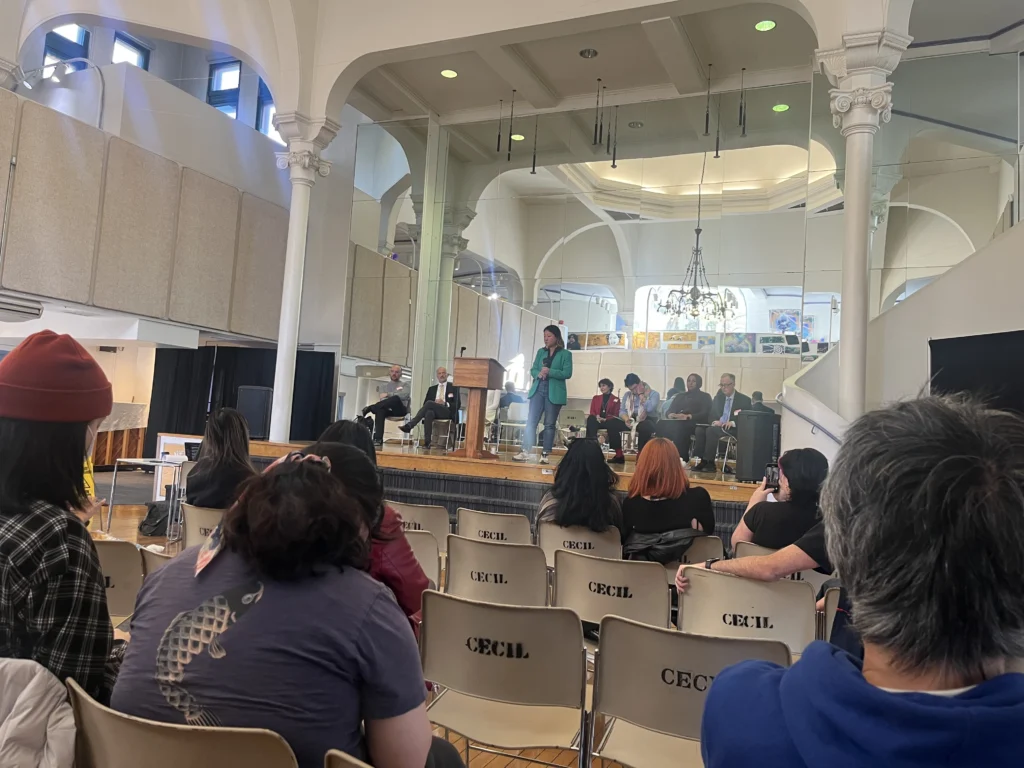
At an all-candidates meeting on Oct. 17, candidates discussed small business protection, affordable housing and community spaces. The panel was organized by the Chinatown Advocacy Network and held at Cecil Community Centre.
BECOME A GREEN LINE MEMBER TODAY
From ward 10 Spadina-Fort York, Ausma Malik, Paul Nash and Andi Hoàng-Lefranc attended. From ward 11 University-Rosedale, Terri Hawkes, Mike Layton, Gian Pileri and Diana Yoon attended.
Protecting small businesses and affordable spaces
The Toronto Chinatown Land Trust (TCLT) and other organizers asked questions about supporting small businesses in the neighbourhood. The organizers brought in experts and community speakers to highlight Chinatown’s history of displacement and the role local businesses play in maintaining cultural and community relationships.
Arlene Chan, a Chinatown historian, discussed the importance of protecting longstanding businesses, including Great China Herbs, a family-run herbal medicine store that nearly closed earlier in 2026. The Green Line covered the flash-mob meant to mark the store’s closure, but the store ended up remaining open because of the community’s strong feelings for its continued existence.
Layton proposed measures to protect these businesses from rising rents, and addressed the need for planned support. Malik highlighted her work advocating for rent controls for Chinatown businesses and giving small businesses priority access to rental spaces.
Nash, who came fourth in Spadina-Fort York, proposed seeking grants and tax breaks, while Hawkes, who also came fourth in University-Rosedale, spoke about protecting cultural projects and creative work connected to Chinatown.
Affordable housing and preserving cultural identity
Candidates were asked about what they’d do to protect tenants and preserve affordable housing.
Malik and Layton both highlighted funding for affordable housing acquisitions through community land trusts.
Yoon, who came second in University-Rosedale, highlighted the need for affordable rentals, while Hoang-Lefranc, who came fifth in Spadina-Fort York, proposed stronger tenant protections and more funding for community organizations.
Speakers also discussed what it means to protect Chinatown’s cultural spaces. Hoàng-Lefranc suggested funding for local businesses and young entrepreneurs, while Nash suggested wider sidewalks and public art to make the area more pedestrian-friendly.
Documenter’s perspective, Joel Sawmadal
I recently attended the Toronto Chinatown Land Trust’s (TCLT) Annual General Meeting where the organization’s leadership provided members with key updates on the group’s work over the past year, while also addressing questions and concerns from present community members. I was struck by the strong commitment by attendees, most of whom were Chinatown residents or individuals with deep personal ties to the neighbourhood, to participating in decisions affecting their community’s well-being.
Since then, I’ve followed other non-profit advocacy groups in the neighbourhood, one of those being the Chinatown Advocacy Network. I learned about the All Candidates meeting through the TCLT’s social media, as the two organizations work closely together, and a friend who volunteers for CAN.
Throughout the meeting, I again observed a strong sense of community engagement. Attendees showed a keen interest in understanding the candidates’ policy platforms and how they would best represent their interests and address the neighborhood’s needs. It was encouraging to see democratic accountability in practice, as the candidates engaged directly with community members and advocates, acknowledged their concerns, and offered responses to the issues raised.
Although I’m not a resident of Chinatown myself, this meeting, like the TCLT’s AGM, reflected principles of civic engagement and democratic participation that I believe would benefit neighborhoods across the city. It’s this strong culture of community organizing and participation in local politics that makes me admire Chinatown and the work of the neighbourhood’s various advocacy groups.
Fact-Check Yourself
Sources and
further reading
Don’t take our word for it — check our sources for yourself.

Join the conversation