
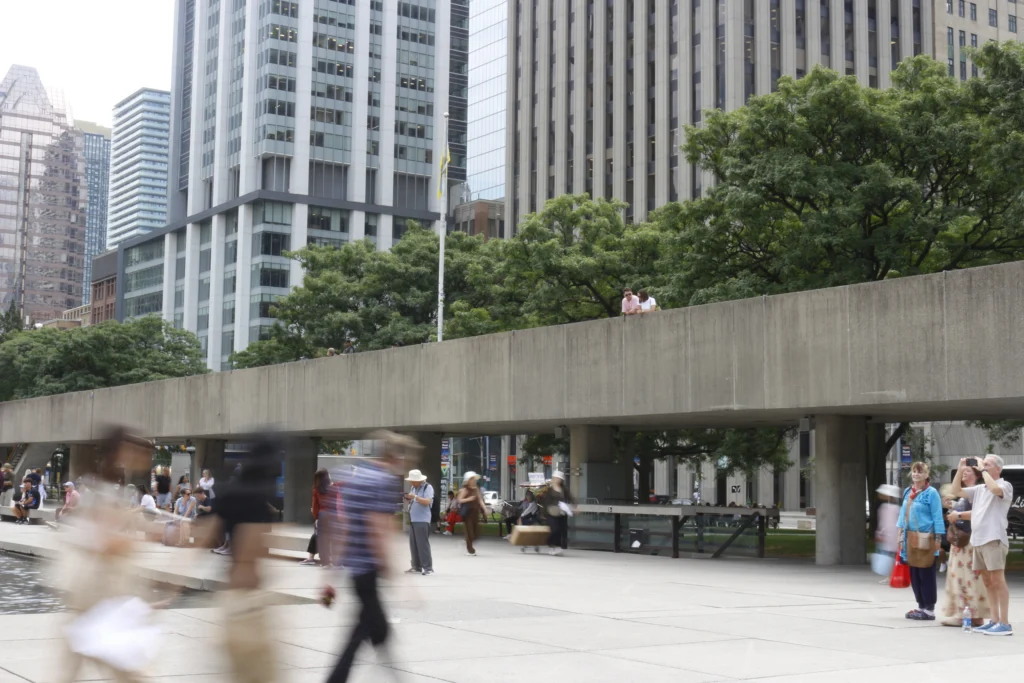

There’s so much to care about in Toronto from housing to food.
Over the course of the last three months, we dove deep into which level of government is responsible for what, what elected officials and city staff do, where the money to fix problems comes from and where it goes.
But it’s a lot and it can be hard to pinpoint exactly what things you care about and should prioritize.
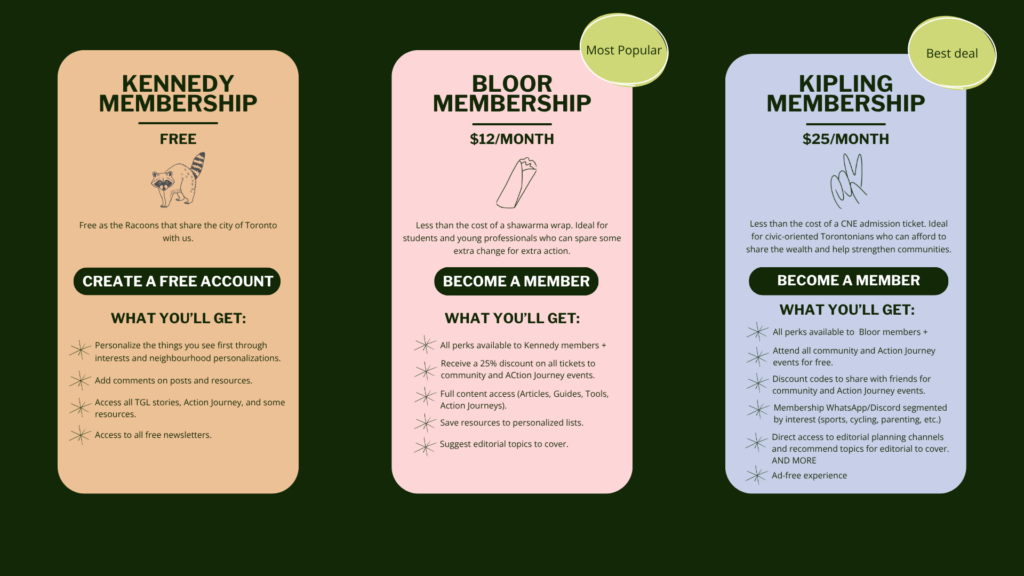
BECOME A GREEN LINE MEMBER TODAY
You’re only one person too. You can’t possibly be at every housing rally or every TTC accessibility meeting. Some neighbourhoods lack infrastructure, while others are fighting to protect local businesses and community spaces. And this is all before getting into climate change, AI data centres, construction and more.
All these issues are in a competition with each other, and when you feel like political figures aren’t listening, it’s normal to want to give up.
Being civically engaged doesn’t mean you have to follow every City Council meeting or know every policy like the back of your hand. Plus, there’s a chance that you got involved with city politics a little late into the election season and that’s okay. We’re here to plant the seed for civic engagement, so that you can be as involved as possible for future elections — not just the one happening on Oct. 26, 2026.
The first step is figuring out what matters to you, understanding the problems behind it, how to evaluate people responsible for addressing it and going from there.
So here’s how to do that, one step at a time.
1. Evaluate your everyday life
Before you read a campaign or research City Council decisions, think about your own life experiences.
What makes your life in Toronto harder? What do you wish your neighbourhood had more of? What building or community hub would upset you if it disappeared?
Maybe your commute takes too long and maybe you can’t afford to live next to your workplace.
These experiences can be the starting point for identifying broader public issues. Start by writing down three things you would change about living in Toronto, and then add one thing about your community that you want to protect or preserve.
Try to be specific. Instead of writing “transit,” choose to dive deeper. Maybe you can say, “I want my commute to be faster in the morning because the transit is unreliable.”
Now do this three times. If you have more than three, don’t limit yourself. Write down as many concerns or priorities you have and evaluate which has the most influence on your overall wellbeing.
I usually identify my top priorities by rating them on a five-point scale. I ask myself:
- How much does this affect myself and my community?
- How much do I want to see this changed?
- How relevant is this issue right now?
2. Educate yourself on how City politics works
For the last 12 weeks, we’ve been creating explainers on how to understand and navigate City of Toronto processes. It’s super important for you to look into who is responsible for your problems, how to navigate the City of Toronto website, how something becomes policy and so much more.
You can see every single explainer over at our series’ landing page. It’s a good, accessible place to start because once you understand how the municipal government works, you’ll be able to actually create change in the right places.
Here are a few things you can learn:
- What level of government is responsible for which issue.
- What the Mayor of Toronto can and cannot do.
- What a Toronto City Councillor can and cannot do.
- How to make a deputation at Toronto public meetings
3. Evaluate the proposed solutions, not just promises
So now you’ve identified the issue, you’ve examined the evidence and found out which level of government or elected official can help, the next step is to evaluate potential solutions.
This is where we have to understand the difference between a concrete plan and a broad promise. Imagine a candidate promises to make transit more reliable without explaining the steps they’ll take to meet that goal or the budget that will pay for it.That’s not someone you can reliably say will follow through.
Ask yourself four questions:
- What’s the proposed action? What are they saying they’re going to do?
- Do they actually have the authority to do it? If a city councillor candidate is saying they’re going to fix OSAP cuts, you might steer away from them because the educational funding is a provincial issue.
- How will their plan be funded and is it realistic? You can learn more about how the city gets its funding and where it goes by checking out our explainers.
- What’s the timeline? You don’t want to be waiting for a development forever.
If you need to look at a candidates’ track record and learn how to factcheck it, you can check out The Green Line’s checklist.
4. Contact the person who can help
You don’t have to figure out your political priorities by yourself. You can ask questions to academic/industry experts, city politicians and community organizations. Matter of fact, you can also email a journalist because they have to pool together existing resources and sites to do their jobs.
You don’t have to construct some long letter or present a complete policy proposal.
Just do these four things:
- Identify who you are and what neighbourhood/ward you live in.
- Describe what the problem is and where it’s happening.
- Tell them what you’ve learned and what else you wish to know.
- Ask them for what it is you need. This might be more information, next steps, a contact or more.
5. Evaluate what you feel and think afterwards
Decide what progress looks like for you. After contacting a few people, you might want to save the response, note any promises they make and just return when some time has passed.
If you decide later on that the priority you researched isn’t an issue for you any more, then that’s okay. Being involved doesn’t mean finding one thing and sticking to it. People are bound to switch in and out of different realms to find what actually resonates with them and matters.
And don’t force yourself to care for the same issues everyone else does. You have unique experiences that might be different to others’.
If you’re looking to gain some more insight into actually being more active in your community, you definitely can. We have an explainer on how to fix your neighbourhood’s problems beyond the Toronto municipal election, because civic engagement isn’t just tied to election period.
It’s been fun chatting with you folks every single week. It’s the last part of our 12-week civic explainer series. I’ll miss you all but I hope you continue to use everything to expand your civic knowledge.
As always, if you have any questions or civic-related ideas, you can email me at aia@thegreenline.to.

Fact-Check Yourself
Sources and
further reading
Don’t take our word for it — check our sources for yourself.
Join the conversation