


If you’re curious about Toronto’s history, read on.
There are a lot of books out there about how Toronto has evolved as a city, from illustrated architectural guides to heavy academic accounts and even fiction stories set here. If you look for recommendations online, you might find uncurated Reddit threads, shameless self-plugs or lists that just fall flat.
So, if reading recs have failed you before, don’t worry, our list is TGL-approved.
BECOME A GREEN LINE MEMBER TODAY
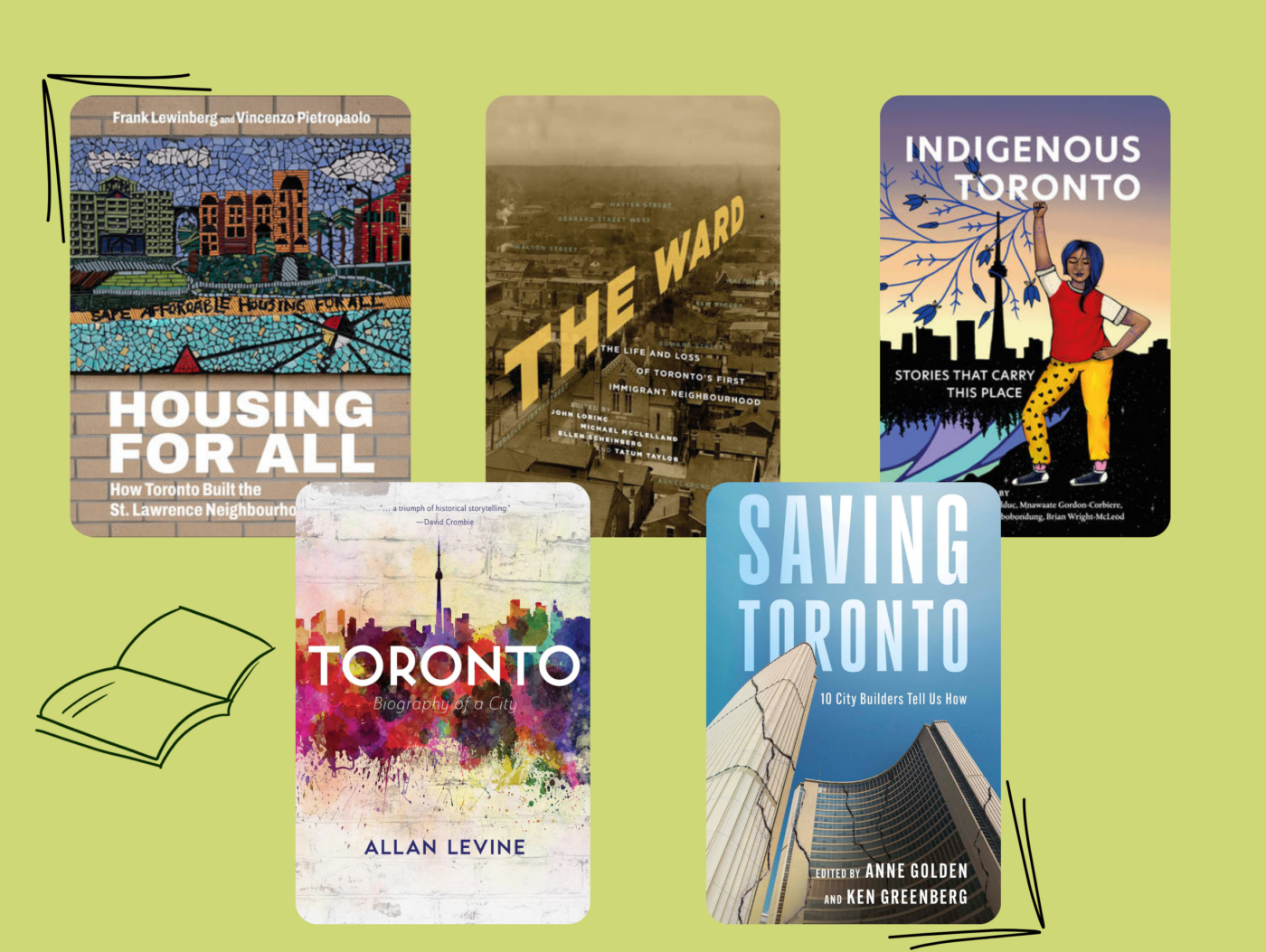
You don’t have to sift through AI slop or generic lists with 100 suggestions, because we compiled a list of just five essential reads to understand Toronto’s history.
First, check out the five titles we chose, then, if you want to know more about each book and why we’re recommending it, keep reading!
- Indigenous Toronto: Stories That Carry This Place, edited by Denise Bolduc, Mnawaate Gordon-Corbiere, Rebeka Tabobondung, and Brian Wright-McLeod
- Toronto: Biography of a City by Allan Levine
- The Ward: The Life and Loss of Toronto’s First Immigrant Neighbourhood, edited by John Lorinc, Michael McClelland and Ellen Scheinberg
- Housing for All: How Toronto Built the St. Lawrence Neighbourhood by Frank Lewinberg and Vincenzo Pietropaolo
- Saving Toronto: 10 City Builders Tell Us How by Ken Greenberg and Anne Golden
Indigenous Toronto
You can’t talk about Toronto’s history without acknowledging the Indigenous Peoples who have lived on this land for centuries, and who continue to fight for recognition and justice.
Indigenous Toronto: Stories That Carry This Place is a rich anthology that’ll introduce you to many facets of Indigenous presence in the city through contributions of elders, scholars, journalists, artists and historians. Each piece takes on a different format, including Q&A, poetry, theatre, personal memoirs and academic essays — and topics, including urban parks, art murals, heritage plaques, trailblazers and more.
According to the publisher Coach House Books, the anthology “explores the poles of cultural continuity and settler colonialism that have come to define Toronto as a significant cultural hub and intersection that was also known as a Meeting Place long before European settlers arrived.”
It’s a great starting place to get to know Toronto from an Indigenous lens.
Toronto: Biography of a City
Allan Levine starts his book by thwarting the hate Toronto gets, without offering a rose-coloured view of the city. What he promises is an incomplete biography-style account of how the city has evolved. No grand philosophical or abstract musings nor detailed historical dives. Just a story of people and events at major Toronto moments.
Levine begins the book with the story of Étienne Brûlé, the first European settler believed to have set eyes on what became Toronto. He anchors the story to a park dedicated to him — linking the historical figure to local commemorative plaques. He gives summaries of Canadian colonial history since then and dives into stories of immigration that made Toronto the multicultural city that it is. Levine also dedicates a chapter to urbanist and activist Jane Jacobs (who inspired Jane’s Walks, if you don’t know — check it out). Lastly, Levine presents a brief overview of mayoral politics and takes a jab at public discourse around everything and anything in Toronto.
Read this book if you want a brief history of most Toronto things with a bit of wit, but keep in mind the book was published in 2014 and doesn’t reflect the city’s more recent happenings.
The Ward
“The Ward” or what officially used to be St. John’s ward, refers to the area between College to Queen and University to Yonge streets. From the 1840s until the Second World War, before it was largely bulldozed in the 1950s, the Ward saw waves of Toronto’s early immigrants settle in from Irish, Jewish, Italian, African American and Chinese diasporas.
This book is an anthology examining the lesser-known stories of this neighbourhood, from sex workers, public baths, playgrounds, tuberculosis, policing and more. The essays featured were penned by politicians, novelists and academics specializing in income disparity, criminology, social work and other disciplines, each offering a unique perspective on the space that’s now known as Toronto’s downtown core. The book also includes maps and photos that any history buffs would enjoy.
Housing for All
How do you build one of Toronto’s most popular neighbourhoods? With this book, you can learn directly from the architect and city planner who helped shape the St. Lawrence area in the mid 70s.
Author Frank Lewinberg joined forces with photographer-writer Vincenzo Pietropaolo to share a first-hand account, beautiful photos and resident vignettes of how the neighbourhood revitalization project came to be — and how the work of planners, politicians and activists made it affordable for the community.
Saving Toronto
Instead of looking at history, this book tries to give a blueprint for Toronto’s future.
The city builders in question are urban and cultural planners, Coun. Josh Matlow, an expert in municipal finance and more. Each one shares their own analysis of “problems in governance, finances, housing, transport, environment, technology, infrastructure, social cohesion and public space and offer coordinated responses.”
The book was published this April, so it’s hot off the press if you’re looking for the most current read.
If you want to dive deeper, make sure to check the Local History Publications and digital archives at Toronto Public Library.
Of course, there are many other books about or set in Toronto. We also have a list of five books to fall in love with Toronto’s culture. If you’re looking for a specific genre or topic, let me know at yara@thegreenline.to and I’ll dig into it next.
Fact-Check Yourself
Sources and
further reading
Don’t take our word for it — check our sources for yourself.

Join the conversation