

TL;DR
- Seven safe supervised consumption sites have closed across the province; two in Toronto.
- Harm reduction outreach coordinator Aaron Woznica urges community members to reach out to politicians, donate their time or money and pick up a naloxone kit.
- Read a step-by-step guide to preventing an overdose.
The Ontario government ended funding for seven essential supervised consumption sites across the province to transition to a new model on June 13.
Moss Park Consumption and Treatment Services (CTS) and Fred Victor CTS were two of the sites forced to close.
In a press release, the government says it will work with municipalities and community partners to, “ensure a safe, coordinated wind-down of provincial funding for the drug injection sites and successful transition into the new model of recovery.”
BECOME A GREEN LINE MEMBER TODAY
The new model of Homelessness and Addiction Recovery Treatment (HART) Hubs will not provide the same level of care as supervised consumption sites (SCS).
HART Hubs are a place to step off the street and get referred to support services; it is not an emergency service or a space where drugs are going to be consumed safely under supervision.
While people are connected to primary care, case management and housing, the hubs could’ve existed in tandem with supervised consumption sites, according to Aaron Woznica, a harm reduction outreach coordinator at Parkdale Queen West Community Health Centre (PQWCHC).
“It was never really an either-or choice that had to be made,” he explains. “What we’ve done is ideologically frame these issues of homelessness and substance use and overdose as you’re either using drugs or you’re not, you’re either deserving of our help or not. That’s just not the reality of how people move through their journey with substance use,”
Woznica says Torontonians will see more people struggling with the site closures.
Removal of the safe consumption sites means “less space for people to safely use their drug of choice without fear of fatal overdose,” he says. “Less space for people marginalized or stigmatized within our healthcare system to connect to life-saving and life-sustaining services.”
When you take away an indoor space to do something, you’re forcing people to do it outdoors. So, you’ll see more people injecting or smoking without support and without a safe space to use and discard their supplies, Woznica explains.
The site closures also mean there won’t be immediate monitoring and support when an overdose happens. Woznica adds, “We know it’s happening more when we look at the EMS calls in the areas where we’ve lost sites.”
How to help someone who is overdosing
- Always say out loud what you’re doing, “Hey, can you take a deep breath for me?” “I’m going to shake your arm.
- Look for symptoms by looking at someone’s chest, shoulders, ribs or back, depending on their position. What we want to look for is a nice, steady and deep rise and fall every five seconds or less. If someone’s able to take three nice deep breaths in a row, five seconds apart or less, they’re probably going to be okay in terms of immediate risk of death.
- Another sign of breathing troubles is their skin colour; people with darker skin, they may look more grey or ashy around the lips. For people with lighter skin, they would be more pale, grey, blue, then purple. Check for symptoms to make sure this is an opioid overdose as opposed to someone drunk, exhausted or in a diabetic coma.
1. Shout and Shake
- Always say out loud what you’re doing, “Hey, can you take a deep breath for me?” “I’m going to shake your arm.
- Look for symptoms by looking at someone’s chest, shoulders, ribs or back, depending on their position. What we want to look for is a nice, steady and deep rise and fall every five seconds or less. If someone’s able to take three nice deep breaths in a row, five seconds apart or less, they’re probably going to be okay in terms of immediate risk of death.
- Another sign of breathing troubles is their skin colour; people with darker skin, they may look more grey or ashy around the lips. For people with lighter skin, they would be more pale, grey, blue, then purple. Check for symptoms to make sure this is an opioid overdose as opposed to someone drunk, exhausted or in a diabetic coma.
- Assign someone nearby to call first responders while you continue the overdose response steps.
- If alone, put 911 on speakerphone.
- Recognize the nearest intersections, buildings and businesses to give specific details about your location to help the first responders find you.
- Describe the physical markers of the person experiencing an overdose. This could include difficulty breathing, skin colour changing, no response, etc.
3. Administer naloxone
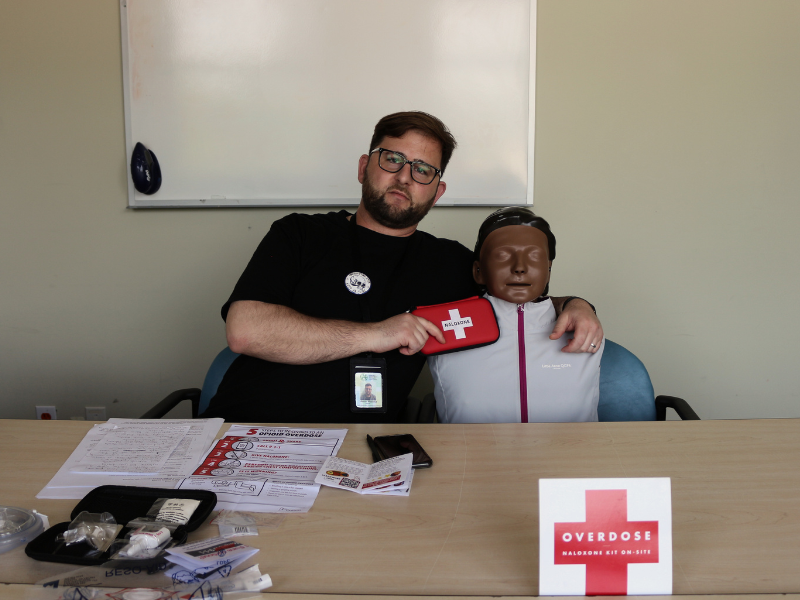
- There are two options to choose from; the black kits are black like your nose hairs because that’s the nasal spray cartridge. The red one is red like your muscle because that’s where the needle on this injectable version will be going.
- There are instructions inside the kits in case you forget, in English and French. There are also gloves and a face shield if you’re trained and prepared to provide rescue breaths.
- If you’re trained in CPR, be prepared after the first dose to administer it.
- When holding the product, one spray once into the nostril and/or one ampule into the arm or leg.
4. Perform CPR
- Perform rescue breathing and/or chest compressions
- To learn CPR in case of emergencies, find a provider near you through the Canadian Red Cross for classes.
5. Ask yourself: Is the naloxone working?
- If no improvement in two to three minutes, repeat steps three and four.
NOTE: Stay with the person and clean your hands after providing care.
How can you help Torontonians fight to bring back SCS and educate yourself further on overdose prevention:
- Email your MPP and let them know how these closures affect your community for the worse.
- Sign petitions from Progress Toronto and the Harm Reduction Advocacy Collective around refunding and expanding these services.
- Pick up a naloxone kit.
- You can find them at any local pharmacy (no prescription needed) or at any PQWCHC site.
- When you pick up a naloxone kit from PQWCHC, staff will provide instructions on how to administer it.
- Consider donating to the Harm Reduction Advocacy Collective or the Toronto Indigenous Harm Reduction group.
- If you see someone in need, who isn’t a risk to themselves or others, call 211 and they’ll come to support the individual.
- Stay up to date on Toronto’s drug supply.
- If someone needs urgent medical care (unresponsive, bleeding, seizure, difficulty breathing), call 911 right away. Tell the dispatcher clearly that this is a medical emergency.
- For a mental health crisis, call 211 and ask for Toronto Community Crisis Services. Trained mental health responders will be dispatched to help.
- To connect someone sleeping outdoors with outreach and housing support: call 311 and ask for Streets to Homes (S2H). They operate 24/7 and can send outreach workers to offer shelter, housing and basic needs.
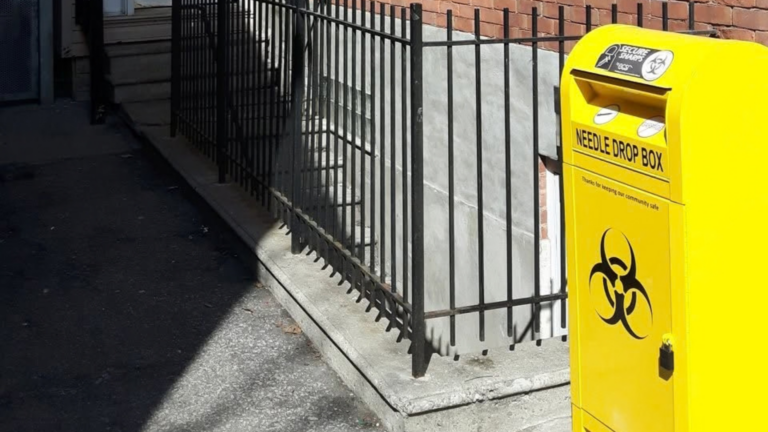
- For help in collecting sharps (needles or discarded substances) on public property, call 311 for their safe removal and disposal.
Fact-Check Yourself
Sources and
further reading
Don’t take our word for it — check our sources for yourself.

Join the conversation