
Dreaming of a sunny Italian summer? If you’ll settle for a non-intimidating recipe to make fresh pasta at home without fancy equipment, we got you.
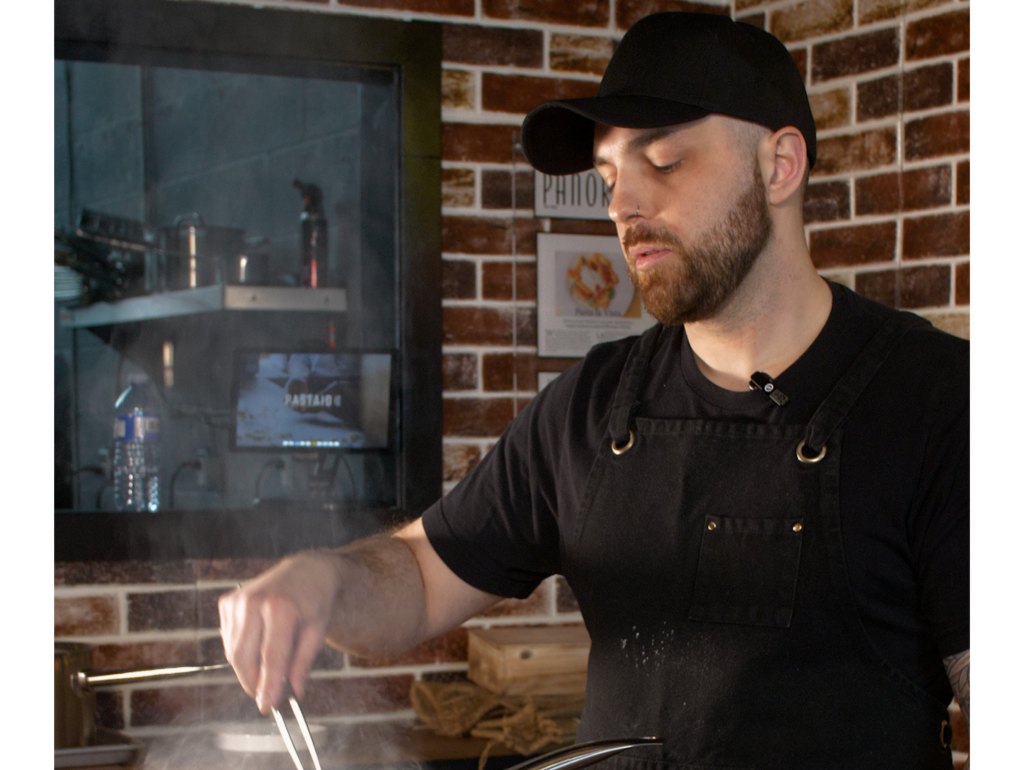
We asked chef Anthony Sestitio – who runs Pastaio, an artisan pasta shop in Humber Summit in North York – to share an easy, affordable hand-made pasta recipe.
He showed us how to make pici all’amatriciana, a hand-rolled thick spaghetti with cured meat and tomato sauce. Even though this dish isn’t particularly traditional, it holds a special place in his heart.
BECOME A GREEN LINE MEMBER TODAY

“It’s a pasta that my grandmother would make around the Christmas time of the year,” Sestitio told The Green Line.
“It sort of brings me back to my childhood and [reminds me] of a special moment every year that I would have with my grandmother, where she would be hand making this pasta, that she didn’t really know the name of.”
Want to make chef Sestitio’s recipe? Watch his video below, download the PDF of his recipe, or scroll down for the step-by-step instructions.
Ingredients
To make your own pici dough:
- 200g of 00 flour
- 100g of semolina flour
- Around 150ml of warm water
- Around 10ml of olive oil
To make the amatriciana sauce:
- 150g guanciale (or any cured meat), diced
- 400g of canned tomatoes, preferably cherry tomatoes
- 1/2 tsp of chili flakes (which you can adjust to taste)
- 1/2 tsp of black pepper
- Salt, to taste
- 40-50g of pecorino romano (or any cheese), finely grated
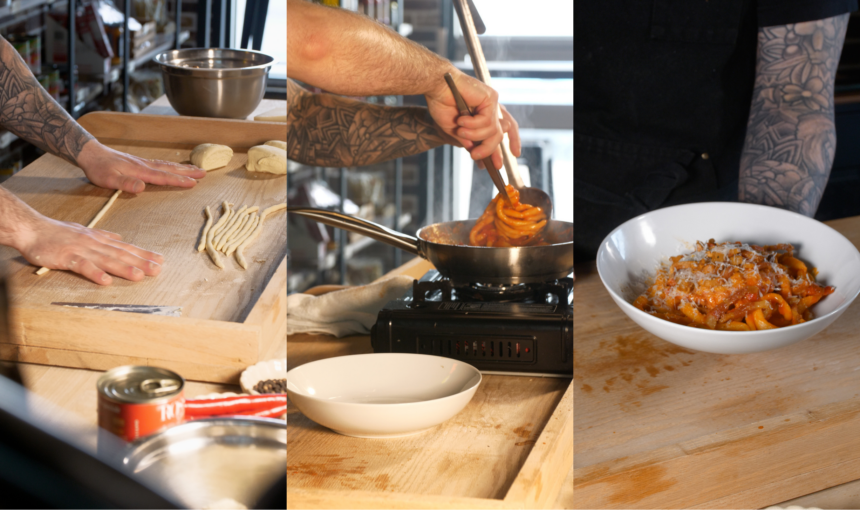
: Lucas Bustinski/The Green Line.
Step 1: Make your own pici
Mix the 00 flour and semolina flour.
On a clean countertop, add the flour mix and form a “well” with the bottom of a bowl.
Add water and a drizzle of olive oil.
Bring the water-flour mixture together with a spoon or spatula, going in a circular motion.
- Once the mixture becomes a rough and lumpy mass, switch to using a bench scraper or your hands to bring the dough together.
Once the dough starts to come together and starts to form a ball, begin the process of kneading.
- Fold the dough and press downward then, forward with the palms of your hands.
- Turn the dough 90 degrees, fold and press downward then, forward, and repeat.
- Repeat the process for 7 to 8 minutes, or until the dough comes together.
- You’ll know that your dough is ready when you have a smooth, homogenous mixture with no lumps or clumps. It should have a little bit of bounce back when you poke it.
Let your dough sit and rest covered with a towel for about 17 minutes. This allows the gluten to sort of relax and form a strong network that you can use to hand shape and roll out this dough.
Once the dough is rested, you’re ready to start shaping.
- Break the dough into smaller, more manageable pieces by cutting it down into strips using a bench scraper or a knife.
- Start rolling the pici, which is basically hand-rolled, thick spaghetti. Use even pressure with your hands going both downwards and outwards simultaneously.
- You’re looking for shapes that are even – as best as you can, but certainly it’s not going to be perfect.
Once all of your pici is rolled out, lay it out on a mesh rack.
- If you don’t have a mesh rack at home, you can use a kitchen towel or paper towel or anything that can elevate the pici off of a tray or your countertop, in order to get some airflow under there.
- This allows the pasta to dry out a little bit as you work on your sauce.
Step 2: Prepare your Amatriciana sauce
Cut your cured meat into little batons.
Add the meat to a cold pan, and turn on the stove to medium heat.
Cook until nice and crispy.
Once you’ve rendered all the fat, move the cured meat into a separate dish, leaving 1 to 2 tablespoons of fat in the pan.
Turn off the heat and add the dry spices, chili flake and our cracked black pepper.
Once you can smell the spices, add the tomatoes right from the can into the pan.
Turn the heat back on to medium.
With the back of a fork, start breaking apart the tomatoes.
Cook for 10 to 15 minutes. You’ll see that the sauce has thickened up a little bit and the cherry tomatoes have broken down.
Step 3: Cook the pici
Once you’ve cooked the sauce for 10 to 15 minutes, drop your fresh pici into a pot of boiling, salted water.
Cook the pici for 3 to 4 minutes. It will float when it’s near done.
Step 4: Combine the pici and sauce
Once the pasta starts to float and you can feel that it’s nice, tender and slightly al dente, pull it out of the water and bring it directly into the pan of sauce.
Make sure to drag a little bit of the pasta water into the sauce to help thicken it.
Toss the pici in the sauce for 2 to 3 minutes, until well coated.
Add in about half of your crispy cured meat, just to get it up to temperature.
Cook for 2 more minutes Then, turn the heat off.
Grate a big handful of your cheese.
Give the mix 2 or 3 tosses.
Step 5: Plate and serve
Plate your pasta and sauce.
Garnish with some more grated cheese and whatever’s left of your crispy cured meat.
Cost breakdown
- One onion – $1.88
- A bunch of green onions – $0.77
- Garlic – $1.31
- Bag of red and yellow bell peppers – $3.44
- A bottle of extra virgin olive oil – $14
- A bag of uncooked jasmine rice – $5.37
- Unsalted butter – $8.98
- Fresh thyme – $300
- 1 lbs of salted cod – $10.99
- A can of callaloo – $3.99
- 350 g of fresh callaloo – $8.99
About the chef
Chef Anthony Sestitio has been a professional chef in Toronto for about 20 years. In 2019, he started Pastaio (or pasta maker in Italian) to sell fresh hand-made pasta, host events and offer catering services.
Sestitio’s inspiration for Pastaio came after a couple of trips to Italy.
“I rediscovered my culture and rediscovered what it means to cook Italian food the right way and use simple ingredients,” he tells The Green Line. “I wanted to bring back that sort of simplicity and that authenticity to the fresh pasta scene here in Toronto. Cooking to me is about keeping it simple. It’s about being honest with your ingredients and focusing on quality.”
Sestitio notes that in light of Toronto’s food insecurity crisis, it’s becoming more and more difficult to obtain ingredients that would have otherwise been approachable many years back – including the guanciale (cured meat) and pecorino cheese he uses in the pici recipe he shared. That’s why he encourages people to substitute ingredients with what they can access.
“I think that this is a moment where we have to focus again on simplicity and how to use whatever we have available to us,” he says. “I think pasta is a great way to achieve that. I mean, when you think about it, you’re putting together a dish with minimal pantry items – flour, water, flour, egg, whatever the case may be. Right. It doesn’t get any easier than to prepare something that is sustainable in today’s market.”
Fact-Check Yourself
Sources and
further reading
Don’t take our word for it — check our sources for yourself.