
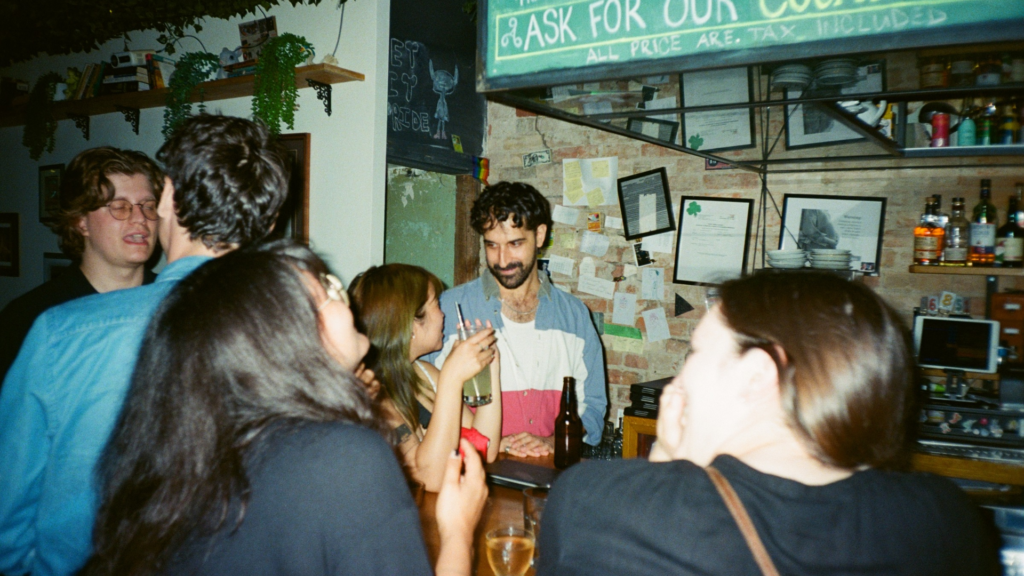

What if you had a say in how your local bar is run?
Community has always been at the heart of the beloved Danu Social House in Parkdale — and as of last month, bar-goers can officially be part of its decision-making process.
On Oct. 9, Danu celebrated becoming a community-worker-owned co-operative. By the end of the month, its finances are more encouraging than ever.
BECOME A GREEN LINE MEMBER TODAY
Joshua Zachariah, who opened the bar in 2022 and now sits on its co-op board, says he always intended to put the space in the community’s hands. Even as the sole owner for many years, he never ran it alone. Family, friends and patrons have been pouring money and free labour into creating the warm and welcoming vibe Danu is known for. But asking people to actually take the reins took time.
“It takes time to build community space and especially a set of people who want to take on that work ‘cause it’s not just a matter of like, oh, we’re going to live our values, and we’re just going to call this a co-op. It’s like, oh, everyone’s work is about to increase,” Zachariah said.
Now, the community is there and willing to put in the effort, especially after a sombre financial review last fall, when Zachariah shared with staff and involved community members that the bar had never done better than break even, and most of the time it’s done worse than that. Zachariah was paying out of pocket and not paying himself as a worker, relying instead on a full-time government job, but the setup was no longer sustainable.
At that meeting, the response was clear: “We want to take this on with you.”
What’s a co-op?
A co-operative is an autonomous association of people that voluntarily come together through a jointly-owned and democratically-controlled enterprise that benefits the needs and aspirations of the membership, according to the Ontario Co-operative Association. There are many types of co-ops, including housing co-ops and consumer co-ops, like the Karma Co-op market.
A worker co-op is a business that’s owned and democratically controlled by the workers who opt in to be members by either buying a share or paying a membership fee. Members make decisions together on how the business is run, how profit is spent and even how management works. Each member gets one vote. According to Innovation, Science and Economic Development Canada, core principles include voluntary membership, democratic control, autonomy, skill-sharing and more.
The Big Carrot is one example of a worker co-op in Toronto. The eco and health-conscious supermarket has been run by its own staff for over 40 years and offers a workplace and benefits that are attractive to its workers, says Kevin Wilkinson, who works the grocery floor and sits as a co-chair of its co-op board.
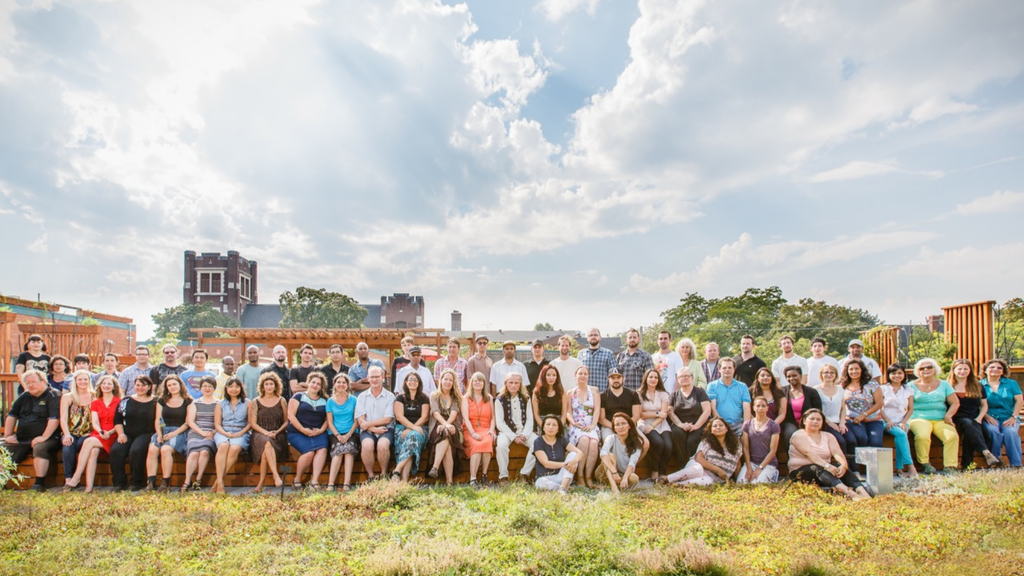
📸: Provided by The Big Carrot Board Of Directors.
Wilkinson adds that workers in regular businesses don’t have a lot of say in what goes on in their lives, what they’re producing, or what they’re doing. “I really like that workers at The Big Carrot have the opportunity to have that freedom to have a say over what goes on,” he told The Green Line. The Big Carrot’s mission states worker-owners act on “the belief that beneficial change can come through collective action.”
“Turnover here is lower than a typical grocery store. People want to stay. They like the benefits. They like the job conditions,” he said.
“There’s a lot more power that people have than regular shareholders or regular workers, and it just matters to the degree that people exercise their participation,” Wilkinson added.
The store’s success was one of the many sources of inspiration and learning for Danu. However, there’s a key difference. Danu is not only a worker co-op, but a community-worker co-op, which means regular bar-goers can be members too.
“To [Zachariah’s] credit, he opted to place control in the hands of the community, and it takes a bit of a leap of faith. But co-ops have been around a long time, and they’re very successful in serving community needs,” says Brian Iler, an expert lawyer in co-ops, who helped Danu make the switch from private business. “It’s a commitment to engaging and involving the community in decision-making,” he adds.
How Danu became a co-op
Step 0: Learn about co-op structures and talk to ones you like
Zachariah said that he’d been talking about and researching co-ops well before Danu officially decided to make the switch. In the lead-up to the change and throughout, he did lots of Googling to look up how to do things.
He also spoke to and visited many types of co-ops in Toronto, Ontario, Montreal and even the UK. In particular, he shouted out Together We’re Bitter in Kitchener, London Brewing Co-operative in London, Ontario and Co-op Bar Milton-Parc in Montreal. Even though they operate in a different industry, he said Toronto’s Karma co-op inspired some bylaws, and The Big Carrot helped figure out management structures.
Step 1: Figure out who the co-op is and how it works
When Danu staff and community members decided to convert the business into a co-op in September 2025, they started the conversation with these baseline questions:
- Who’s in it?
- What work is done by who?
- How are decisions made?
- Where does the money go?
“One of the things that shocked me is how aligned we were on those questions,” Zachariah recalled.
From there, the small group had weekly or biweekly meetings to flesh out how things would work in practice. Early on, they decided the community of bar-goers, not just staff, should be involved.
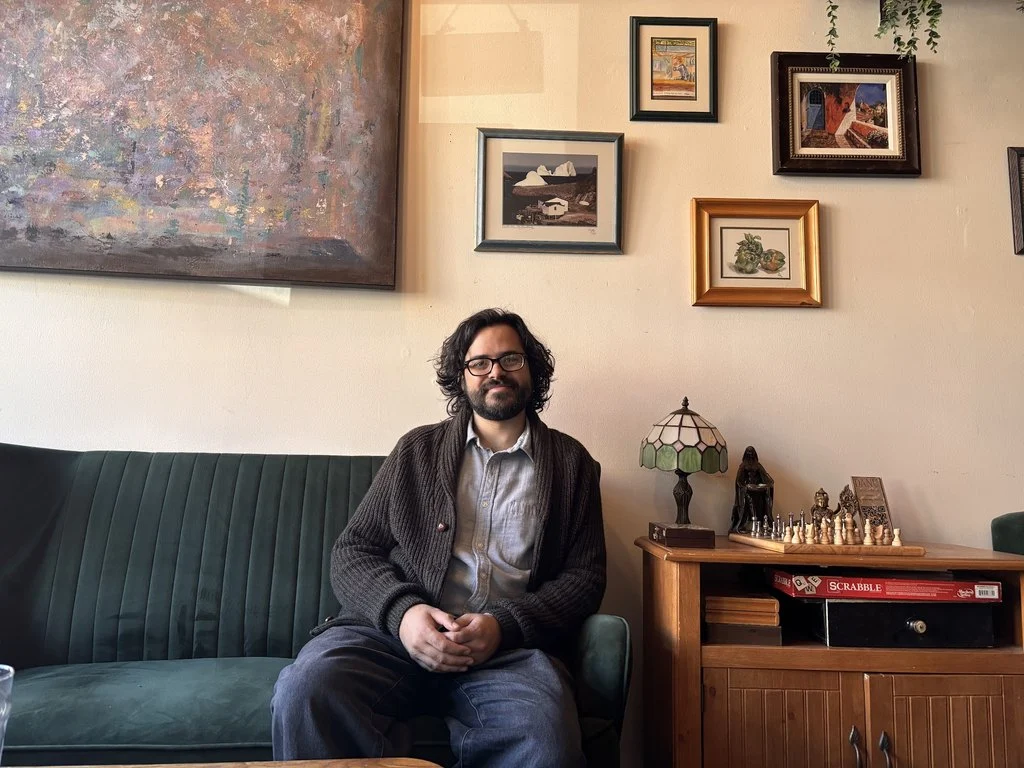
📸: Yara El Murr/The Green Line.
“This community built this place,” Zachariah said. He explained volunteers run a lot of events; people also offer free labour for repairs, so Danu was never just run on worker power. Everyone agreed workers will have the most say in the decision-making process. Eventually, the group decided on a multi-stakeholder structure represented by an elected board of seven. The board includes two chairs, two secretaries, one treasurer and two communications officers who also represent four categories of stakeholders.
- Workers get four seats.
- One seat is dedicated to a representative of the general community, which was left open-ended and put at the centre of the “why and who we serve.”
- One seat represents organizers and contributors, who are non-staff members who run events or do physical work at the bar.
- And the last seat is held by a founder, or anyone who gave significant money or time to the bar. This isn’t necessarily a legacy category, as people can be added to its membership by recommendation.
Step 2: Share the plans with the larger community
In January 2026, Danu presented the basic structure and mission statement to the larger community to ratify it. In retrospect, Zachariah thinks they shared plans with the public and media too early; a lot of things were still changing, timelines were shifting and the announcement added to the pressure.
Step 3: Form a temporary board
“In late June, we made another really intense push which resulted in a temporary board forming in mid-August,” Zachariah explained. Before the board, a steering committee had laid the ground work, and while it was necessary and dedicated, he recommends forming a temporary board sooner. “It was just nice to have a group of people who’s locked in.”
This group dealt with the nitty-gritty, including the legal work, membership mechanisms, decision-making process and more.
A main discussion point was management structure. Some co-ops hire managers that aren’t members to implement board decisions that worker-members decide on. Others have a flat structure where there are no bosses or managers at all.
At the Big Carrot, an elected board appoints an operations manager who’s the head of a regular management hierarchy. The board is separate from upper management and generally doesn’t overlap. It currently consists of seven members: a grocery clerk, a baker, a cashier, a cook, a food service worker, a wellness consultant and an office administrator.
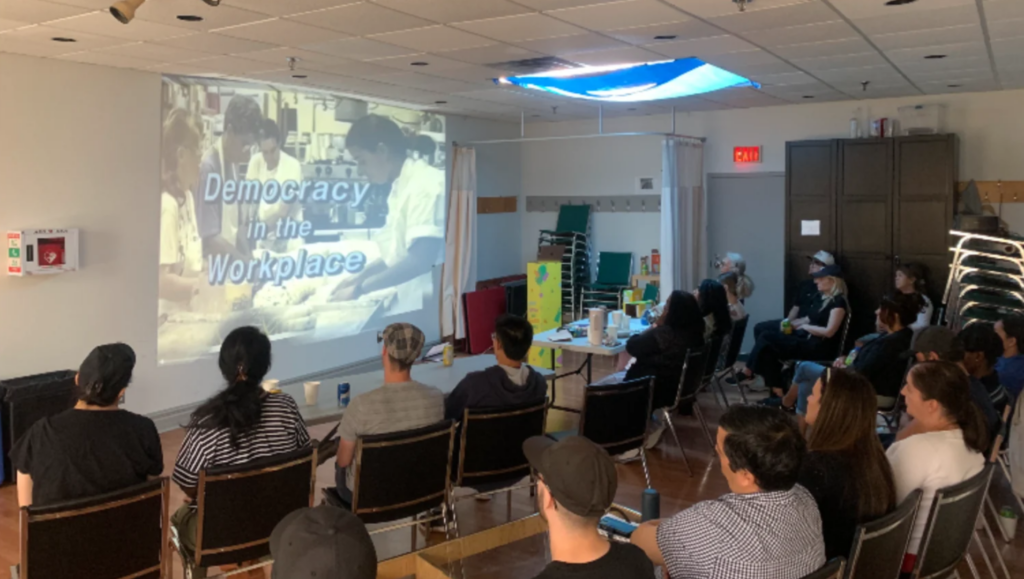
📸: Provided by The Big Carrot Board Of Directors.
One of the bars Zachariah spoke with recommended against a flat structure and recommended having managers, because people naturally took on manager roles, even without the specific designation or recognition.
Eventually, Danu’s board chose an adaptable power structure.
One of the lessons taken from The Big Carrot includes the management and decision-making structure. Both co-ops use an Excel sheet for all the management, financial and administrative tasks that need to be done to run the bar and for sorting out who is responsible for what decision, who needs to be consulted and what the board needs to weigh in on versus what individual staff can decide.
Zachariah notes that working together towards a decision is important, but it’s also helpful to have torchbearers for specific roles. For example, the co-op board decides on contracts and overall budget, but the bar manager finalizes the cocktail menu and rotation. The bar manager also decides on menu pricing, but needs board approval.
The Excel sheet is now a living document that’s reviewed and improved quarterly.
The board also had to decide how a decision is approved: majority voting (which could be 66% or half plus one), consensus or consent (where not everyone has to say yes, but no one can say no) and who breaks ties.
This wasn’t easy to figure out for Danu’s budding co-op committee. “Late spring, early summer, a lot of us were just pretty burnt out by the process. So, things slowed down for a second,” Zachariah said, noting that some conversations take more emotional labour, specifically around internal management structure. The team also had too many meetings and too many meetings about upcoming meetings.
“Sometimes things ended up being more work than I think people necessarily thought, but that didn’t make them stop doing it,” he added.
For large and long-established co-ops, it can get easier. At The Big Carrot, with 50 worker-owners, many hands make light work, Wilkinson said.
The co-op uses super-majorities, or half plus one of the entire membership, for some decisions, while the board makes other decisions after consultations. Significant decisions carry either a duty to consult workers first, and some require formal approval from the membership at a monthly assembly.
“We make motions, and if they pass, they’re carried out. But that’s the way we all like to go forward together on the same page,” Wilkinson said.
“Board members are doing more, but we basically try to make it so that it’s done during work hours and isn’t an overwhelming burden,” he explained. “The people who are the most passionate and informed will tend to run for the board, and you know it’s kind of a labour of love.”
He explained that being a worker-owner can be similar to running a business — and comes with the stress of doing so. “I guess that’s the trade-off for not just being like a cog in someone else’s machine; you also have to know how the whole machine works and try and improve it, find what’s wrong and fix it.”
Step 4: Submit legal paperwork
In late summer 2026, Zachariah submitted articles of continuance. He officially switched Danu from sole ownership under the Ontario Business Corporations Act and incorporated it as a co-op under the Ontario Cooperatives Act. He advises getting a lawyer sooner.
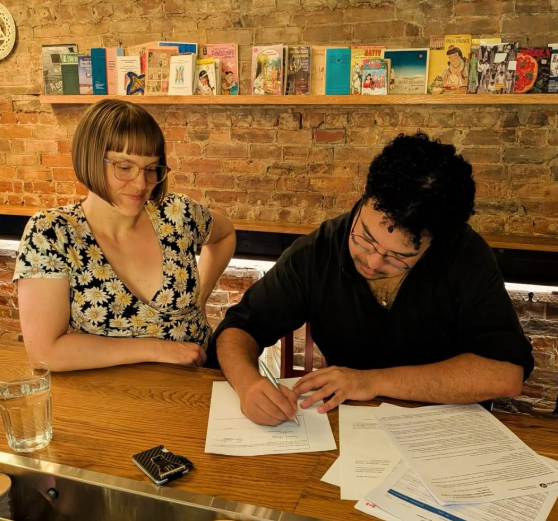
📸 : Provided by Danu Social House.
Iler, who had helped with the paperwork, says the process is actually straightforward.
“The right lawyer will give you tips and make sure you don’t stray too far off the path, but at the same time not end up taking all the money you have,” Iler joked.
Step 5: Open the co-op up for membership
Last month, Danu officially opened up membership applications.
- You can work or go to the bar without being a co-op member, but if you wish to be, you have to apply; you don’t automatically become one.
- For bar-goers, the co-op membership fee is $10 per month, and you get one free drink that month that can be rail, can, draft, wine or non-alcoholic. It’s a low-barrier buy-in — if you go to the bar at least once a month, it’s practically free, and if you don’t, it’s still a low-cost investment that allows you to be part of the community.
- For organizers/contributors, you have to have done one hour of free labour in the past year.
- For workers, you have to have been on contract for three months.
Zachariah explains that when you sign up, you’re not signing up for extra work, but you have the ability now to take on more responsibility if you’d like.
As of Nov. 3, there were eight worker-members, 13 founder members, 14 organizer-contributors and 50 general members with signed agreements. The current co-op board isn’t elected, and not all seats are filled yet. The temporary board is planning for a first Annual General Meeting and election in the spring.
Step 6: Decide where your profit goes
Danu plans on making its finances public and transparent, with the financial priorities laid out in its bylaws. After covering operational costs, profit will be distributed to different buckets.
- First, the bar has debt to pay back. Danu spent $300,000 more than it’s made, Zachariah said. A lot of it, including money from founders like himself, has been forgiven. So the bar stands at $140,000 of non-forgiven debt. Part of this debt has been redirected by a creditor to be payed to the Parkdale & Co-operatives Fund.
- Danu is also planning to put aside a flexibility balance of $5,000 at the beginning of each month, and a reserve fund of $15,000.
- Danu hopes to dedicate some of its profit to a wage top-up. Right now, workers make minimum wage plus tips; the goal is a sustainable wage, which they describe as better than a living wage. However, if in a quarter, the bar doesn’t make enough profit to cover all wage top-ups, worker-members agreed to put that profit into the Parkdale & Co-operatives Fund instead.
- Part of the profit will be dedicated to a “doing good fund” that gives back to the Parkdale community and beyond. It’ll be distributed to organizations and causes as described in Danu’s vision statement as “alternative institutions oriented toward collective good and collective power — in particular, democratically controlled co-operatives that return power and profits to workers and community.” This includes supporting local initiatives that address housing affordability, food insecurity, homelessness and barriers to safe consumption.
Step 7: Keep learning and fixing as you go
As Danu tests its newly anointed model, it’s running into expected and new gaps to be sorted out.
Ongoing conversations include writing a code of conduct and restorative practice framework. When he spoke to The Green Line, Zachariah half-joked about an upcoming workshop he’s attending about conflict resolution, titled “Who gets the bar in the divorce?”
A very good question in my opinion.
Another ongoing concern is where emergency funds will come from. Now that Zachariah is financially cutting off Danu and stepping away from being its sole parent, the co-op needs to figure out other funding. One option that’s been working is a bridge loan program, where community members lend money to the bar and gradually get it back in drinks.
Four decades in, The Big Carrot has changed a lot too. Keeping the principles of democratic decision-making at the heart of the model, the grocery store had to modernize and adapt with its growth and the desire of a growing membership.
At this point, Zachariah isn’t confident Danu’s model will fully stand on its own two feet yet.
“We haven’t yet gotten [to] the point to fully test this, because I’m still doing a pretty similar-ish role to what I was doing. But it’s slowly changing. And that’s what I’d say to anyone trying to do this: don’t make it sharp. That’s risky. I can’t go to this group of people who’ve never run a bar before and be like, do it. This process of passing on the tools to do the roles that they signed up for is going well, but it’s taking time.”
Step 8: Help others build co-ops
While Danu is unique in that it’s switching to a co-op rather than building it from scratch, a lot of the lessons learned along the way could make a blueprint for others interested in the model.
“We’re hoping to be able to go out into the world and convince people to convert to co-ops because there’s a lot of resources out there for people building co-ops, but not a lot for conversions, especially in the service industry, which is where we’d focus at least at first,” Zachariah explained.
On his end, Wilkinson says it’s good to support local co-ops and learn more about them, as they’re a practical way for people to live better and create alternatives to traditional corporations.
“If you’re retiring and you want to pass it on to your workers, I think it’s a very positive thing to do. The Canadian Worker Co-operative Federation can help people with establishing or converting businesses. There’s a supportive local co-op community of people, experts, people who can [provide] legal assistance and accounting.”
Other resources include Ontario’s Co-operative Association, which offers training, educational support and more.
From his chats with interested folks, Zachariah says that it’s not actually a crazy ask to tell a business owner to give ownership away. A lot of them are exhausted and want help shouldering the responsibility of running something in ways that align with their values.
What’s more, he wants to help create an umbrella service industry co-op that can benefit from “economics of scale,” like buying in bulk, having one accountant, one general manager and promotion deals.
To workers, he’s pitching a say in institutions they believe in and care about. To the world, it’s a different relationship to money and business.
“So many people, right and left, are really craving a different game,” he said. Co-ops are an alternative to the pressure of making profit constantly go up, focusing on sustainability and mutual aid instead.
Fact-Check Yourself
Sources and
further reading
Don’t take our word for it — check our sources for yourself.


Join the conversation