
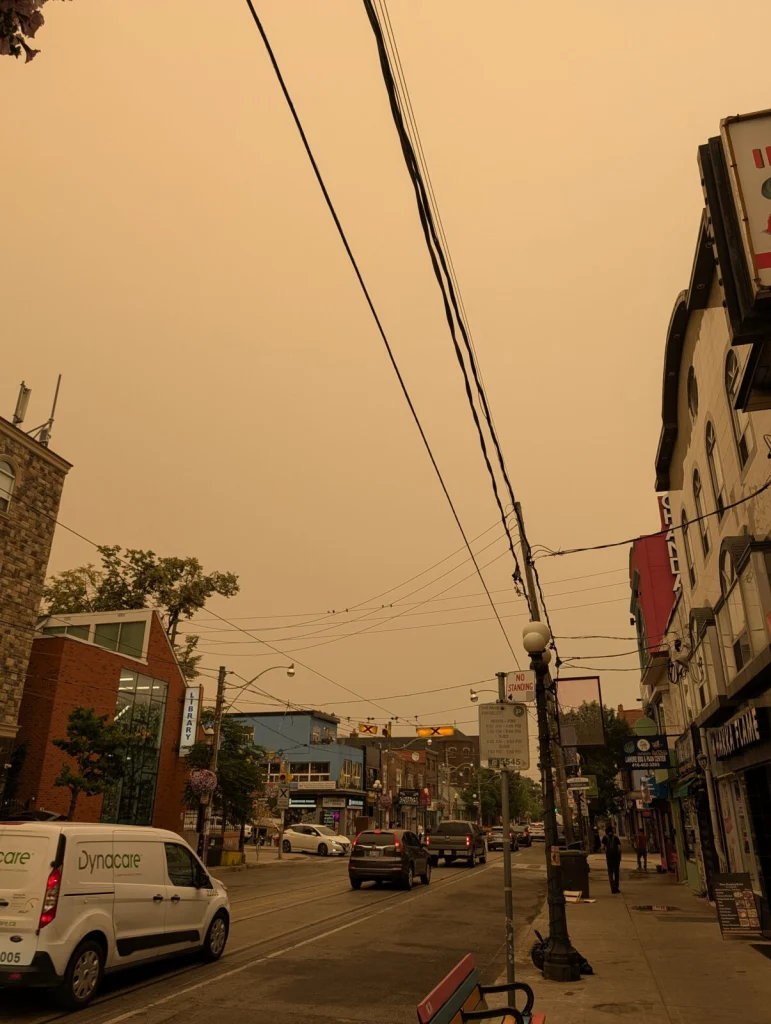

An orange warning for an orange haze.
If you live in Toronto, you may have noticed the orange haze hanging over the city and perhaps even felt a little short of breath.
Forest wildfires in northern Ontario are responsible for the sepia-coloured haze, prompting Environment and Climate Change Canada to issue an orange air quality warning and leading to the cancellation of several outdoor events across the city.
BECOME A GREEN LINE MEMBER TODAY

The City of Toronto announced the cancellation of the FIFA Fan Festival, the public broadcast of the Argentina-England match at Nathan Phillips Square and outdoor pool programming as wildfire smoke “is expected to reach levels that pose a health risk to everyone, regardless of age or health status,” according to a city news release.
The City stated that they consulted Toronto’s medical officer of health before making the decision, as the Air Quality Health Index reached “an average…of 10+, the highest risk level.”
If you can, it’s best to stay indoors, use an air purifier if you have one and, if you need to go outside, wear a well-fitted N95 mask.
The City of Toronto has also extended the hours of indoor pools; other indoor recreation facilities will remain open for heat relief, as the city is also under a yellow heat warning.
Exposure to wildfire smoke may cause eye and throat irritation, coughing, headaches, difficulty breathing and chest pain. Stay alert if you or someone around you experiences one or more of these symptoms.
The City of Toronto is expected to provide further updates tomorrow. You can monitor the Air Quality Health Index here.
Cleaner Air Network
If you don’t have an air purifier at home, you can also visit one of the City’s Cleaner Air Spaces through the Cleaner Air Network:
- City Hall, 100 Queen St W.
- Metro Hall, 55 John St.
- North York Civic Centre, 5100 Yonge St.
- Scarborough Civic Centre, 150 Borough Dr.
- York Civic Centre, 2700 Eglinton Ave W.
- East York Civic Centre, 850 Coxwell Ave.
- City Hall, 100 Queen St W.
- Metro Hall, 55 John St.
- North York Civic Centre, 5100 Yonge St.
- Scarborough Civic Centre, 150 Borough Dr.
- York Civic Centre, 2700 Eglinton Ave W.
- East York Civic Centre, 850 Coxwell Ave.
These facilities use high-standard air filtration (MERV-13 or higher), helping reduce the fine particles in wildfire smoke that have turned Toronto’s skies orange.
Other recommendations
Here are some other recommendations to beat the smoke and the heat.
- Keep windows and doors closed.
- If possible, set your AC to recirculate instead of bringing air from outside.
- Avoid outdoor activities.
- Reduce air pollution (candles).
- Stay hydrated.
- Remain alert to any symptoms.
- Keep pets indoors as much as possible.
- Monitor air quality and heat warnings.
- Keep windows and doors closed.
- If possible, set your AC to recirculate instead of bringing air from outside.
- Avoid outdoor activities.
- Reduce air pollution (candles).
- Stay hydrated.
- Remain alert to any symptoms.
- Keep pets indoors as much as possible.
- Monitor air quality and heat warnings.
Fact-Check Yourself
Sources and
further reading
Don’t take our word for it — check our sources for yourself.




Join the conversation