
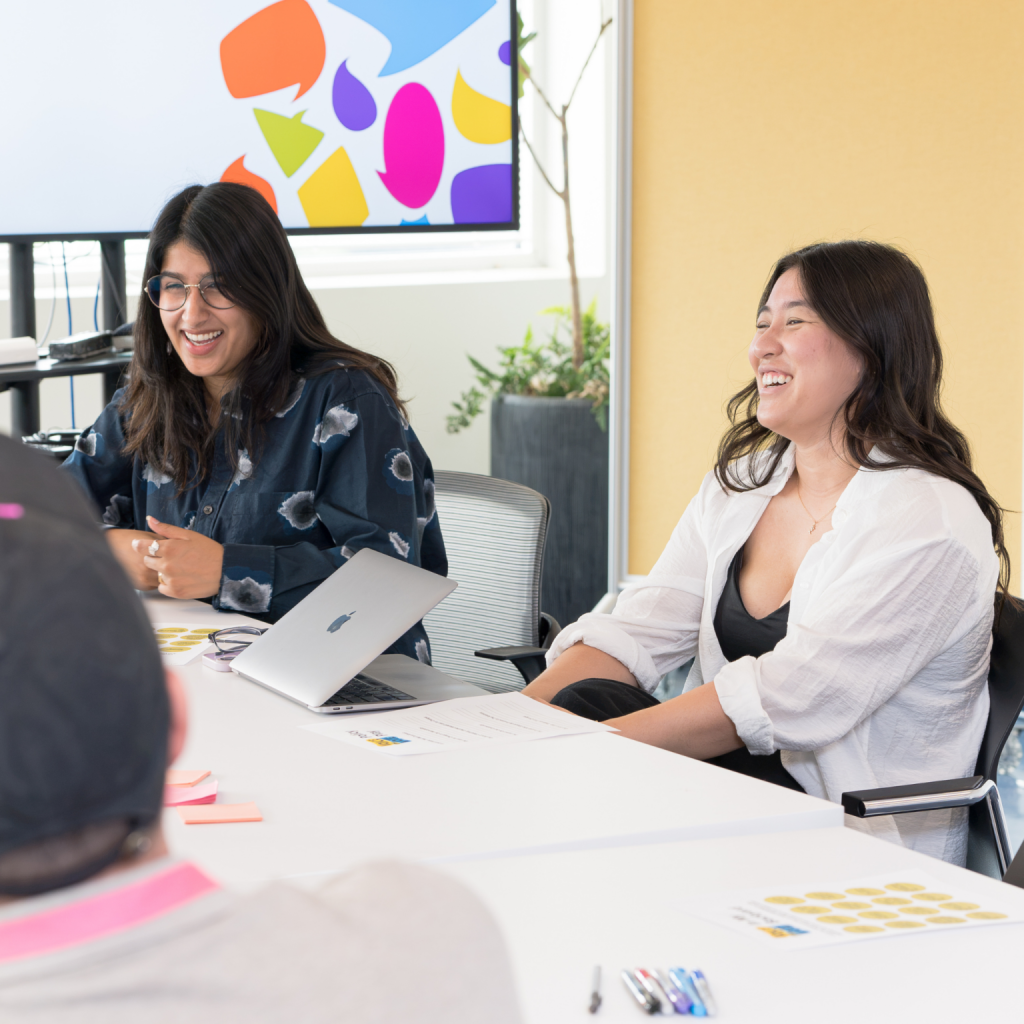
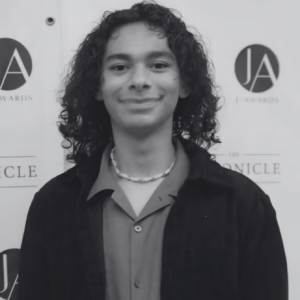
Lifelong community organizer Marium Vahed and former political consultant Abby Tait teamed up to help Torontonians see municipal elections as an opportunity to shape the communities they call home.
Voice the Vote project leads Marium Vahed and Abby Tait share why neighbourhood organizations are key to strengthening civic participation and how residents can get involved before Toronto’s municipal election day.
Through Voice the Vote, an initiative led by the Democratic Engagement Exchange at Toronto Metropolitan University (TMU) in partnership with United Way Greater Toronto, Vahed and Tait are working alongside community organizations to boost civic participation ahead of Toronto’s municipal election this October.
“I saw that we could really shift people’s sense of trust and hope and agency in how they engage with municipal government and municipal elections by simply asking the question, ‘What matters to you, and how can we help?’” Vahed, the project’s co-lead, told The Green Line.
Voice the Vote supports community organizations with training, resources and micro-grants to help residents learn about local issues, engage with candidates and participate in the democratic process. The initiative is rooted in the belief that meaningful civic engagement starts with trusted relationships in neighbourhoods — not campaign signs or election day.
Vahed’s family was part of early community organizations for the Muslim community across Canada, which led her to a lifelong love of civic organizing. She worked as a page at Queens Park during middle school, then went on to be part of Canadian Muslim Vote, North York Community House and the Journeys to Active Citizenship Project.
Tait, also co-lead of this initiative, had never thought of herself as a community organizer. She’s worked for a federal member of parliament, then in consulting and non-profit and arts advocacy. Through her work she’s been reflecting on the communities that shaped her: her dance studio, her mother’s workplace and the local theatre. She’s now manager of public affairs and government relations at United Way Greater Toronto.
Can you tell me about Voice the Vote? What is it and what inspired its creation?
Vahed: We’ve been building Voice the Vote for the past year to engage community voices that haven’t previously been heard in elections, recognizing that voter turnout is 32.9% across Ontario and even lower in municipalities in the GTA. We’re finding ways of building that up.
Voice the Vote is all about engaging community voices in the municipal election this October 2026. We provide resources, training, support for community events and micro-grants to reduce the barriers to doing this work.
We recognize that many community organizations engage in elections on an ad hoc basis. They don’t have the real support, the staffing or the funding to engage. And yet they also have communities that they engage with every day. Should they speak to them about the elections? That’s a lot of people and a lot of power.
Tait: We recognized that these community organizations are already fully trusted within their communities. Community members go to them when they need support, they need help or they have questions. It’s a safe place for them to be curious. So we know that people would trust and rely on this channel for accurate, factual information about the municipal election.
Vahed: It was really about helping community organizations first understand their position and their ability to really make waves when it comes to municipal elections and civic participation.
We provide things like the Vote Pop-Up Toolkit, a voter simulation that demystifies voting; activity sheets that support community dialogue about the issues that matter most to them and connect their daily lives to the issues and roles of municipal government; and a plethora of guides that are coming out.
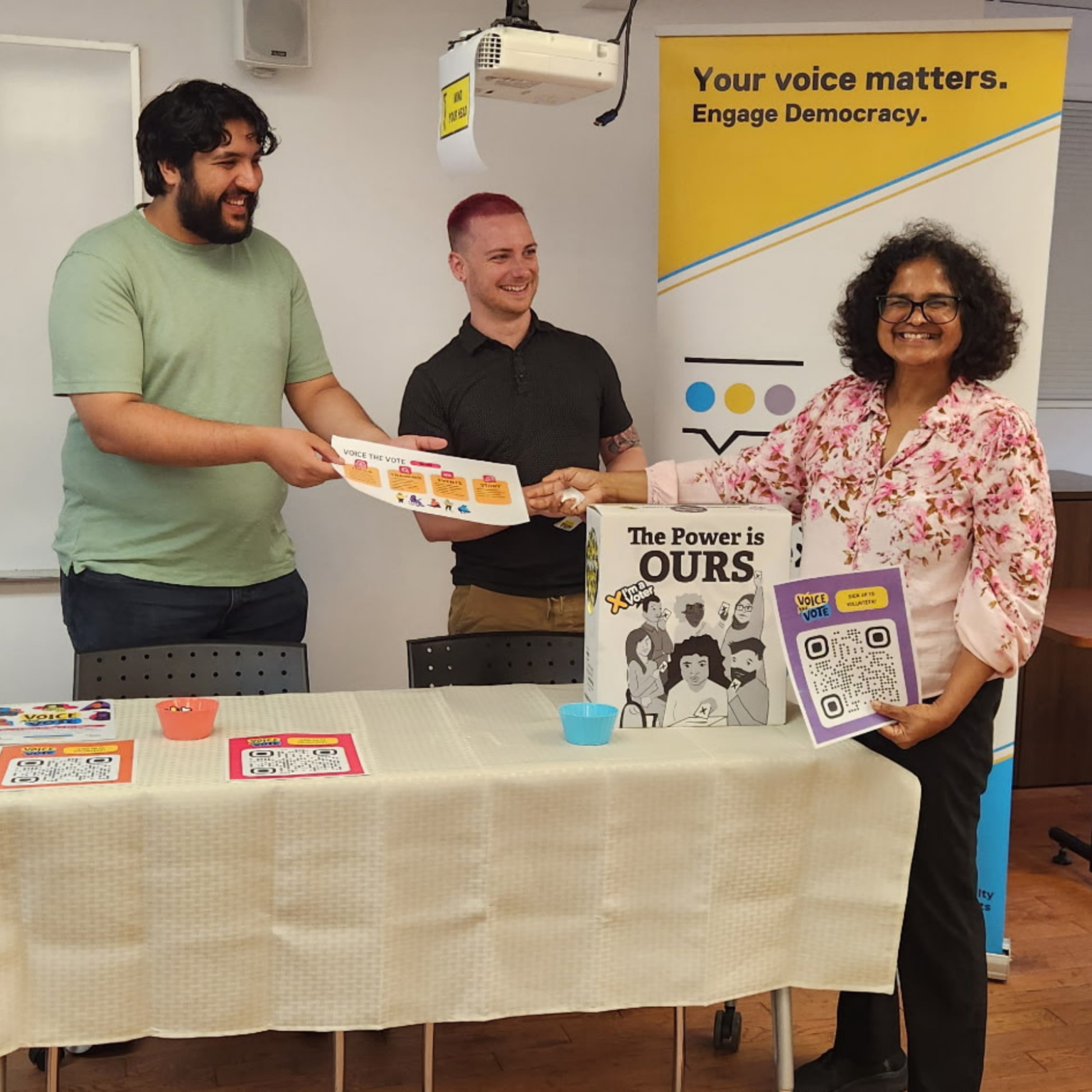
📸: Provided by Voice the Vote.
Why are initiatives like this important?
Vahed: Voice the Vote is rooted in that ethos of prioritizing community voices in everything that we do and being able to create ample space for those community voices to be heard. We’re removing barriers for people to even engage in the first place, and taking the things that we’re learning and sharing them.
Tait: Another grounding ethos for us has been the idea that people are a part of a community before they’re part of this thing called democracy, right?
How do we make voting and engaging in democracy part of community life? When you’re part of a community, you share your voice — and that voice can be through a vote or it can be through other ways.
How are you supporting community organizations beyond providing toolkits and resources?
Vahed: A big part of Voice the Vote is how do we ensure that this conversation is embedded in community spaces? Where are communities already gathering, and how do we enter into those spaces with respect to say “this is something that’s coming up, and this is something that impacts your lives, the lives of the people that you love?”
We’re bringing on an incredible team of people. We’ll have two campaign leads and 13 field staff who are locally rooted in all three of our regions to co-organize community events, to seek out those who have networks in each of the municipalities that we’re engaging with, to provide and offer support in actually running the logistics of the event and to provide access to activity sheets and facilitation guides that make the running of these events smoother and rooted in the work that the Democratic Engagement Exchange at TMU has been doing for the past 10 years.
In the first month that field staff will spend with the Democratic Engagement Exchange, we’re providing them with applied skills training that supports them in understanding how they can run grassroots, successful campaigns, how they can do so both in Voice the Vote and how they could potentially bring those skills back to their own communities.
We’re really excited about this piece because it’s about building the infrastructure for a culture of engagement that lasts well beyond the election.
The other piece is the micro-grants. We recognize that there are barriers to engaging in the election, and some of those barriers are monetary. We are providing $300 micro-grants to individuals and $600 micro-grants to community organizations. We’ll be putting dozens of those out across the three regions because this is our way of saying we recognize that there’s a cost. We want to lift that burden so you can focus on what you do best, which is on your community.
With the micro-grants, we really want to find ways of encouraging creative ideas about how people can participate civically. Part of that is providing some support for those who might want to host a Voice the Vote event that draws from our activities and resources, while also leaving room for creativity.
Ultimately, these are non-partisan micro-grants, so we’re not going to be supporting activities focused on endorsing candidates or anything like that.
How can people learn more or get involved?
Vahed: Follow us on LinkedIn, on Instagram, and check in with our website because we are going to have those be the the primary hubs for all upcoming information, which includes yes, the micro-grants and the application cycle for them, all of the resources and the order forms for those resources and our trainings
Fact-Check Yourself
Sources and
further reading
Don’t take our word for it — check our sources for yourself.
Join the conversation