
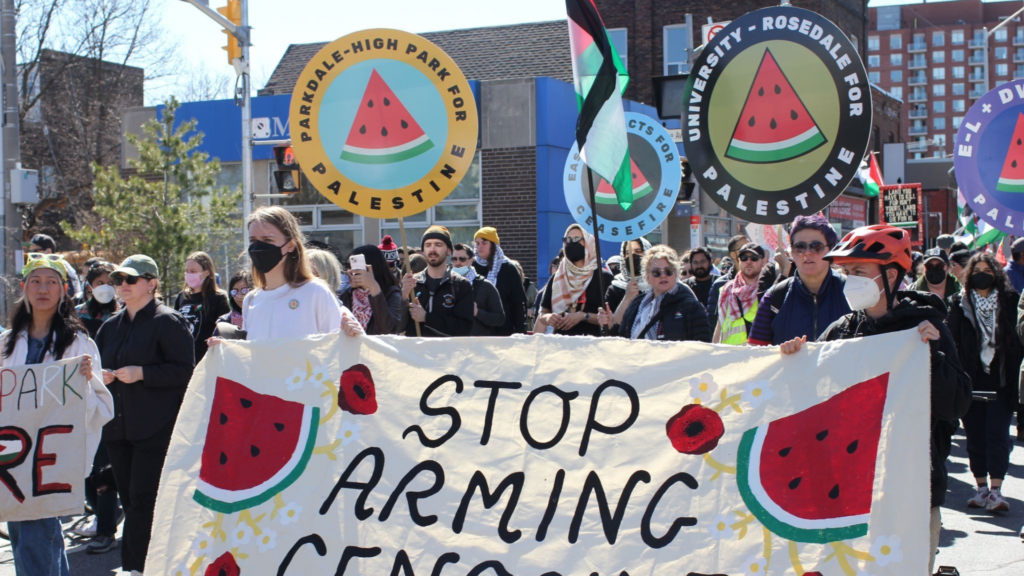
Torontonians have a lot of local issues to worry about, from neighbourhood developments to city services — yet a global topic, Israel’s genocidal actions in Palestine, was a recurrent mention in the 2026 municipal election.
It comes as no surprise given how active local groups have been in advocating for a stop to massacres overseas — and Canada’s role — for three years now.
Last month, we saw concrete and hyperlocal ways this played out in Toronto politics, from activists discouraging locals from voting for Brad Bradford because of his participation in “Walk with Israel” events (among other reasons) to neighbourhood groups surveying candidates about a “war bank” and police budget.
BECOME A GREEN LINE MEMBER TODAY
While few elected representatives explicitly speak up about their support or opposition for either Palestine or Israel, some have been called out for the way they’ve participated in or commented on protests.
For example, Christopher Chiasson, host of “Toronto: the politics show,” reached out to Coun. James Pasternak to ask about his support of “Walk with Israel” when Pasternak tweeted that “The Middle East conflict […] should be kept off our streets and out of the classrooms of Toronto.” Journalist Samira Moyeddin shared a screenshot of a Facebook comment allegedly made by candidate David Magazzinich saying “Press that knee harder. Let him join George Floyd” in response to a video of a police officer sitting on top of a protester in a march for Palestine.
Local activists have told me those comments have been front of mind this election season.
“I really want to highlight this election around the things politicians say. We have a lot of politicians that have said incredibly racist things, incredibly dehumanizing things. They’ve called people terrorists. They’ve been very Islamophobic. Even if they’re not voting on a motion of like, ‘hello, I’m voting on being an Islamophobe,’ that still matters,” says Dasha K., a community organizer in Toronto who wanted to use only her last initial to keep her employment safe.
However, even though the federal government dictates foreign policy, municipal representatives also vote on motions related to the issue. Perhaps the most cited is the city’s police budget and the recent, controversial bubble zone bylaw. Another is the Defence, Security and Resilience Bank (DSRB) or “war bank,” proposed to be headquartered in our city.
All these hyperlocal manifestations of the global issue were at the heart of surveys sent to candidates by local pro-Palestine activist groups, spearheaded by Spadina-Fort York for Palestine and including others in Etobicoke, Parkdale-High Park, Toronto Centre and the east end. The groups asked candidates about their stances on the bubble zone bylaw, the DSRB, police budget and divestment from nations and corporations committing war crimes. Some also asked about harm reduction initiatives, clearing encampments and funding shelters and drop-in centres.
Even in the school board races, a group called Toronto Palestinian Families surveyed trustee candidates about politics in the classroom, conflating anti-zionism and anti-semitism and addressing anti-Palestinian racism in schools.
Overall, it’s clear Palestine isn’t just a matter of foreign policy. “We want to keep it as our compass in every level of government,” says Dasha K.
Was this on your mind this election season? What were the political positions that swayed your vote? Let me know in the comments.
Fact-Check Yourself
Sources and
further reading
Don’t take our word for it — check our sources for yourself.

Join the conversation