Wexford/Maryvale is a suburban neighbourhood in northwest Scarborough. It’s filled with detached homes, parks, strip malls, commercial areas, but above all, vibrant communities of newcomers. Fifty-two per cent of Wexford/Maryvale residents were born outside of Canada and 47 per cent of residents speak a non-official language as their mother tongue. The Taste of Lawrence, Scarborough’s largest street festival, takes place here each summer.
Another defining characteristic Wexford/Maryvale shares with the rest of Scarborough: wide, arterial roads — up to six lanes — such as Ellesmere Road, Lawrence Avenue and Eglinton Avenue running east-west, and Victoria Park Avenue, Warden Avenue and Birchmount Road running north-south.
According to Vision Zero, Toronto’s plan to eliminate traffic-related deaths and serious injuries in the city, Scarborough has “the highest ratio of collisions resulting in pedestrian fatalities [31 per cent], compared to 20 per cent in other districts.”
These wide roads built for cars to move quickly pose two major safety issues for pedestrians in Wexford/Maryvale: long stretches of road without mid-block crossings, and dangerous intersections that require crossing six lanes while paying attention to multiple lanes of cars turning left.
“Drivers are looking down the road to make sure that they can squeeze through their left turn before a fast-moving motor vehicle comes in the opposite direction,” David Shellnut, known in Toronto as “The Biking Lawyer,” told The Green Line. “And frequently, because they’re concerned with the huge vehicle coming at them, they aren’t concerned and [are] not paying attention to cyclists coming or pedestrians crossing.
“So, that’s where you see a lot of injuries happen, is on those left turns.”
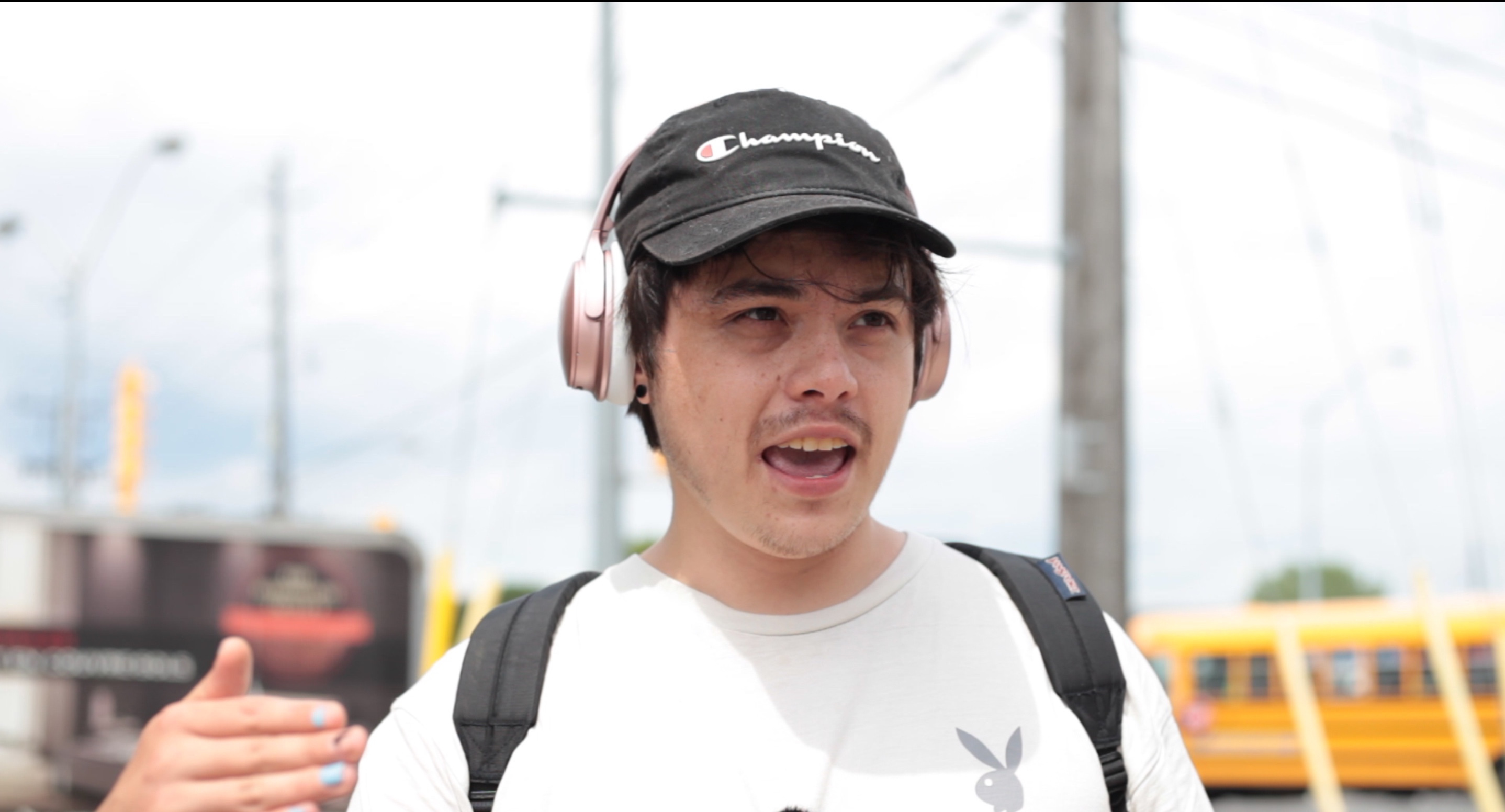
Wexford resident Anthony Miraj gives a message to drivers at Ellesmere Road and Pharmacy Avenue. 📸: ANTHONY LIPPA-HARDY/THE GREEN LINE.
At Ellesmere Road and Pharmacy Avenue, Wexford resident Anthony Maraj summarized how many pedestrians feel navigating these wide intersections: “We’re just walking around, we’re taking our time, it’s hot out — give some courtesy because we want to be safe, too. You’re safe in your big car. We’re not as safe.”
One way to make such intersections safer is with pedestrian head-start signals. This allows pedestrians extra time to cross the intersection before drivers receive a green signal, including drivers making left turns.
The north-south arterial roads have more pedestrian head start signals than the east-west corridors: Victoria Park Avenue has 10 across 4.9 km, an average of about two per kilometre. Warden Avenue and Birchmount Road have eight each across 4.9 km, an average of about 1.6 per kilometre.
Ellesmere Road has two pedestrian head start signals over two km (one per km). One of them is just east of Victoria Park Avenue; the other is at the intersection with Principal Road, where three elderly pedestrians were seriously injured five years before its installation. But Ellesmere Road still lacks pedestrian head start signals at the major intersections of Victoria Park Avenue, Pharmacy Avenue, Warden Avenue and Birchmount Road.
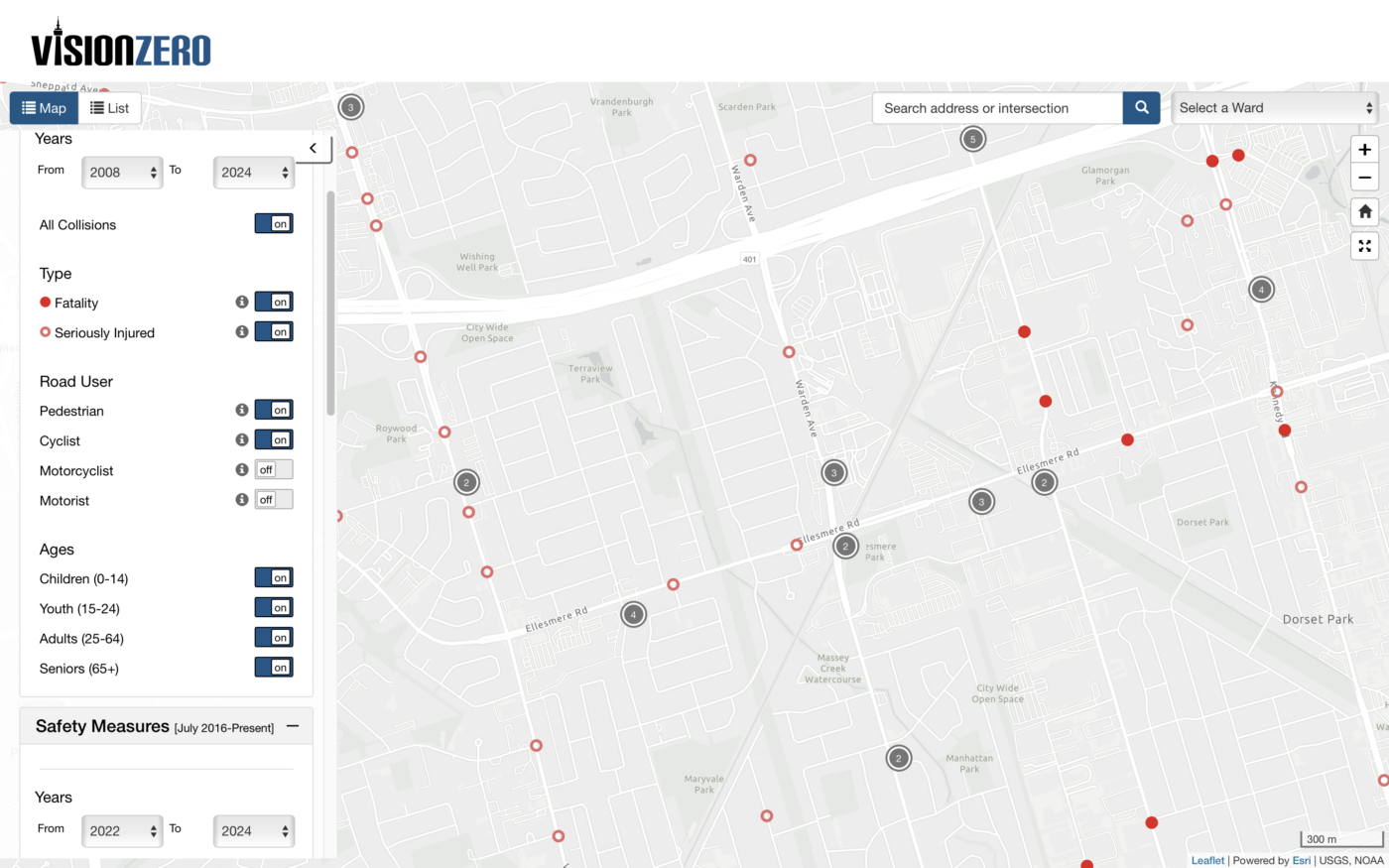
ELLESMERE ROAD HAS SEEN TWO FATALITIES AND 11 SERIOUS INJURIES BETWEEN VICTORIA PARK AVENUE AND BIRCHMOUNT ROAD FROM 2008 TO PRESENT. THAT AMOUNTS TO ONE PEDESTRIAN KSI (KILLED OR SERIOUSLY INJURED) PER 125 METRES. 📸: VISION ZERO.
Lawrence Avenue has one pedestrian head-start signal over 2 km (0.5 per kilometres) at Townley Avenue, which was installed five years after two pedestrians were seriously injured, including a child. But Lawrence still lacks pedestrian head-start signals at its major intersections with Victoria Park Avenue, Pharmacy Avenue, Warden Avenue and Birchmount Road.
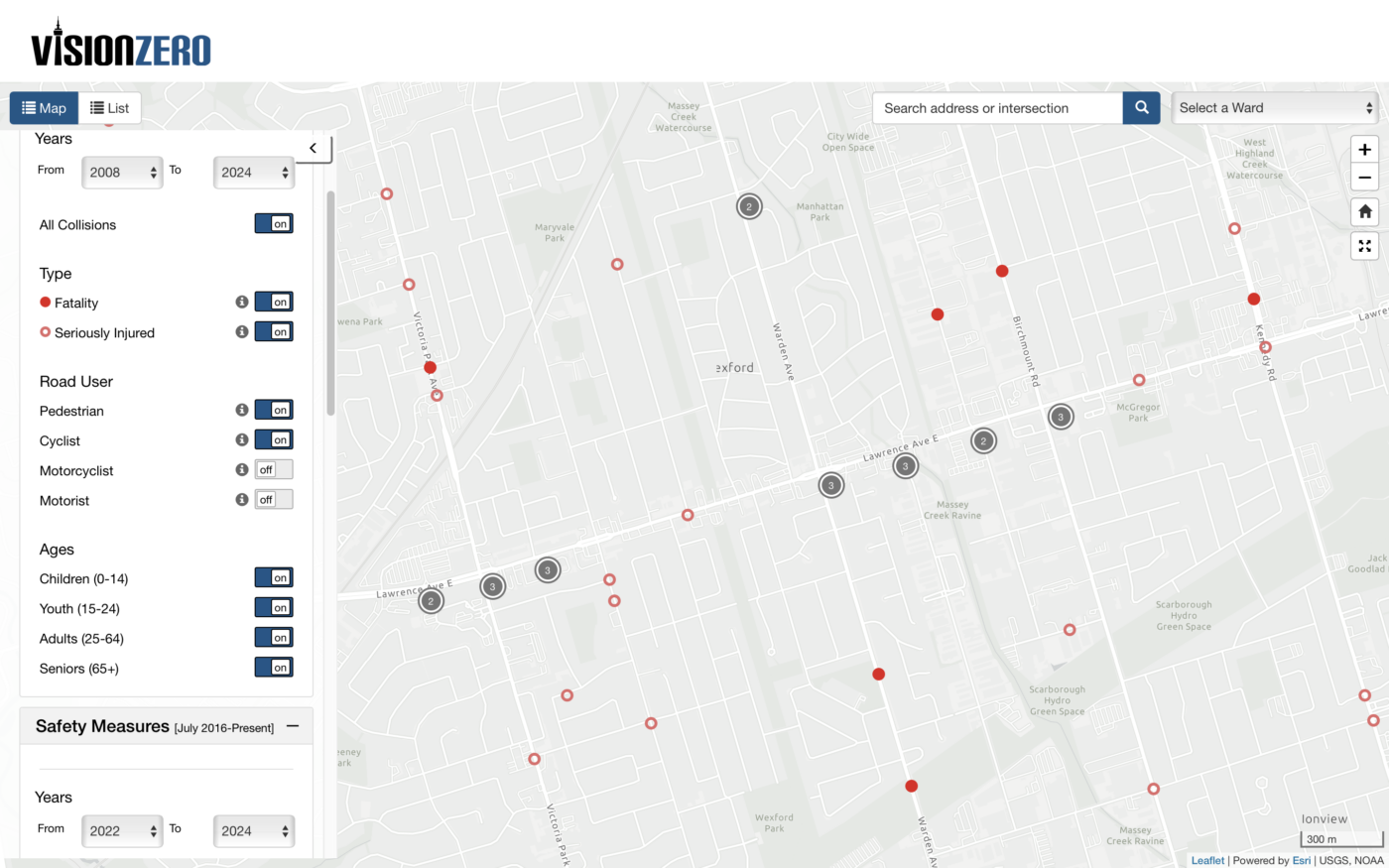
Lawrence Avenue has seen three fatalities and 15 serious injuries between Victoria Park Avenue and Birchmount Road from 2008 to present. That amounts to one KSI (pedestrian killed or seriously injured) per 115 metres — an average of 1.1 per year. 📸: VISION ZERO.
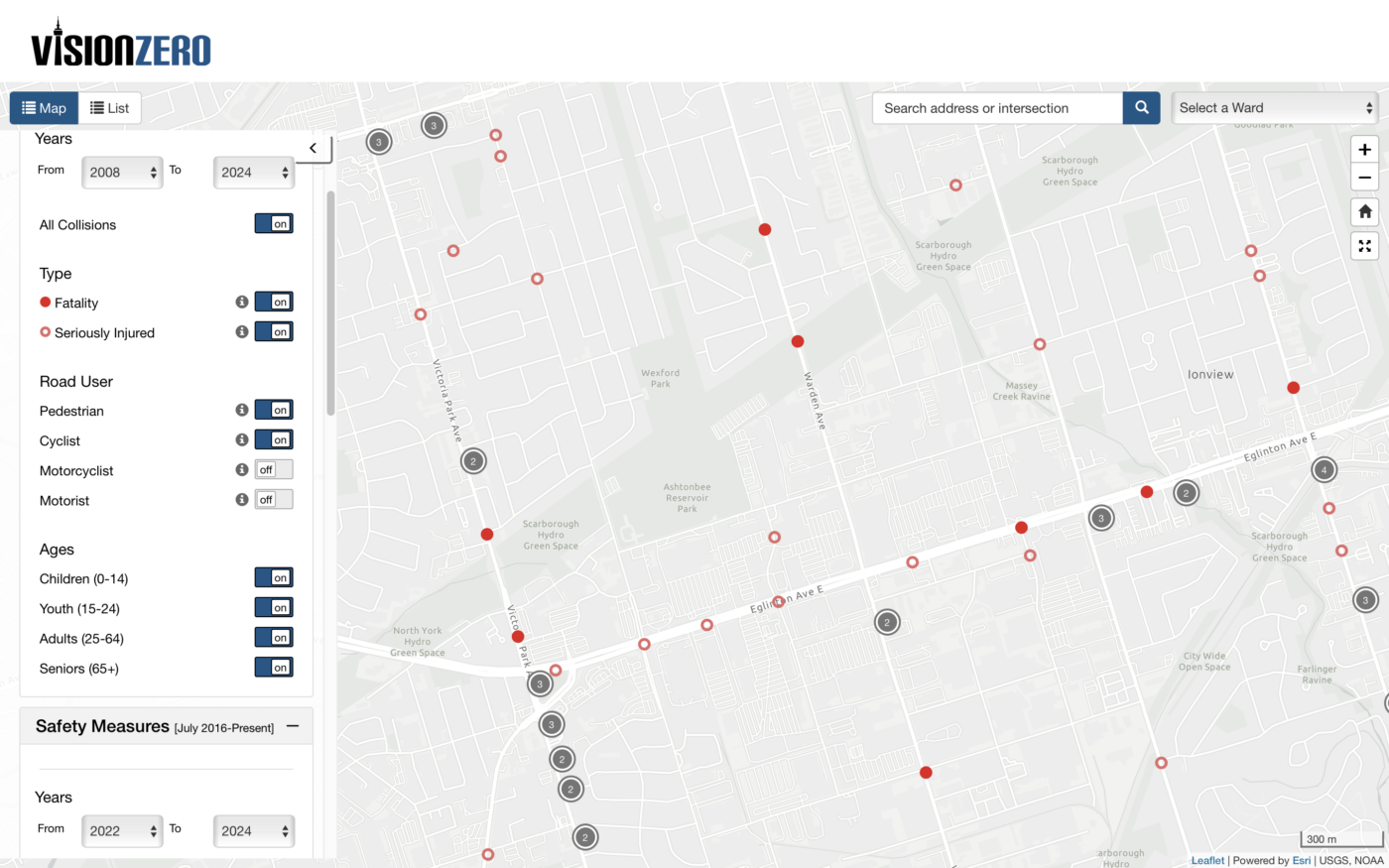
At the bottom of the list, Eglinton Avenue has zero pedestrian head-start signals. The construction-plagued avenue has seen two pedestrian fatalities and 10 serious injuries between Victoria Park Avenue and Birchmount Road from 2008 to present. That amounts to one KSI per 200 metres.
PEDESTRIAN KSIs (killed or seriously injured) along Eglinton Avenue in Wexford. 📸: VISION ZERO.
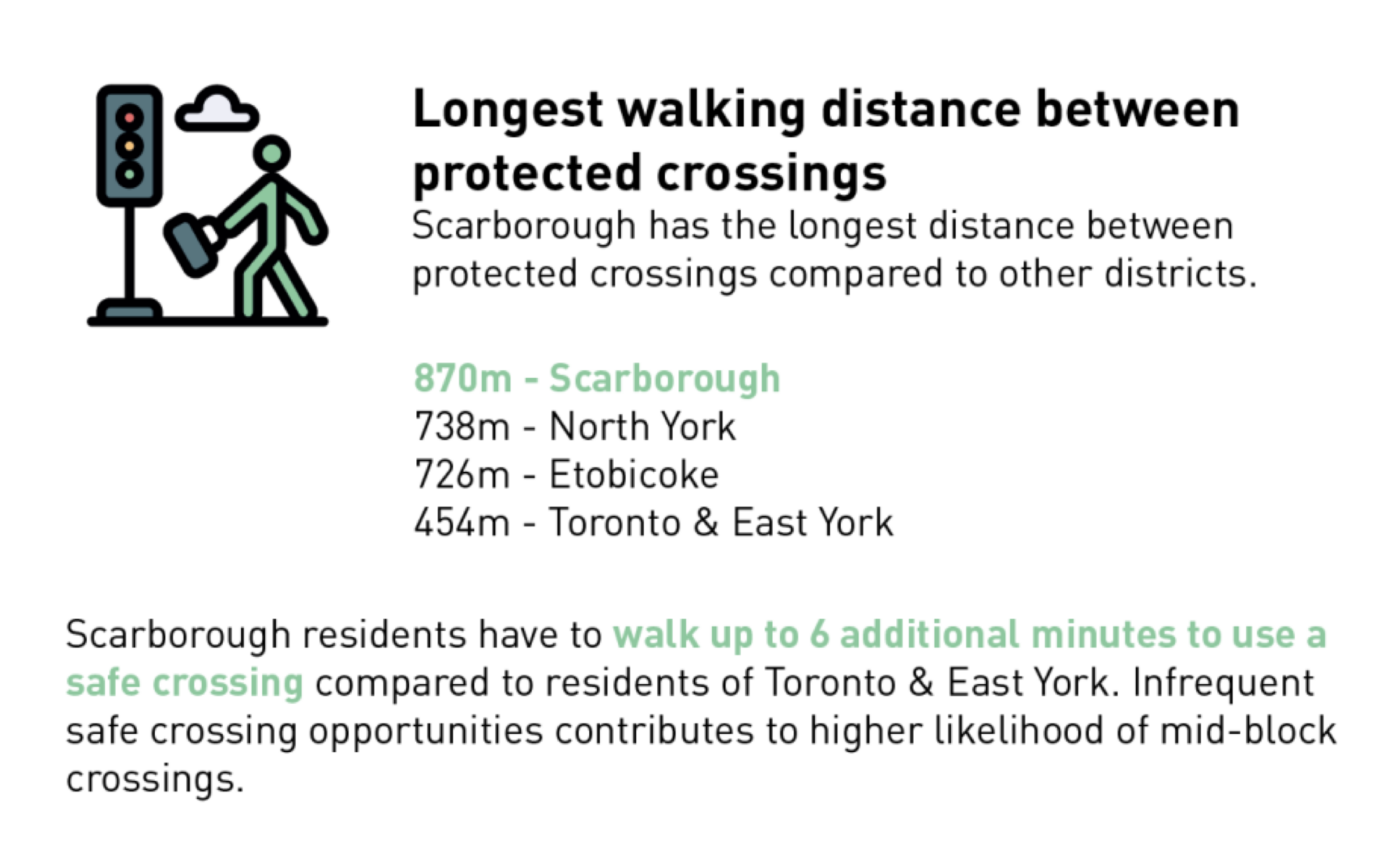
Wexford’s biggest pedestrian safety issue, however, is the lack of pedestrian crossings. This issue cuts across Scarborough, with residents there having to walk an average of six additional minutes to use a safe crossing compared to Toronto and East York, according to Vision Zero.
Vision Zero data on the longest walking distance between pedestrian crossings. The Green Line’s analysis found a significantly longer instance between protected crossings in Wexford. 📸: Vision Zero.
Forty-four per cent of pedestrian KSI incidents are caused by mid-block crossings, compared to 35 per cent in the rest of Toronto. Scarborough’s population is 22 per cent of the city, yet 43 per cent of mid-block pedestrian fatalities in Toronto occur in Scarborough.
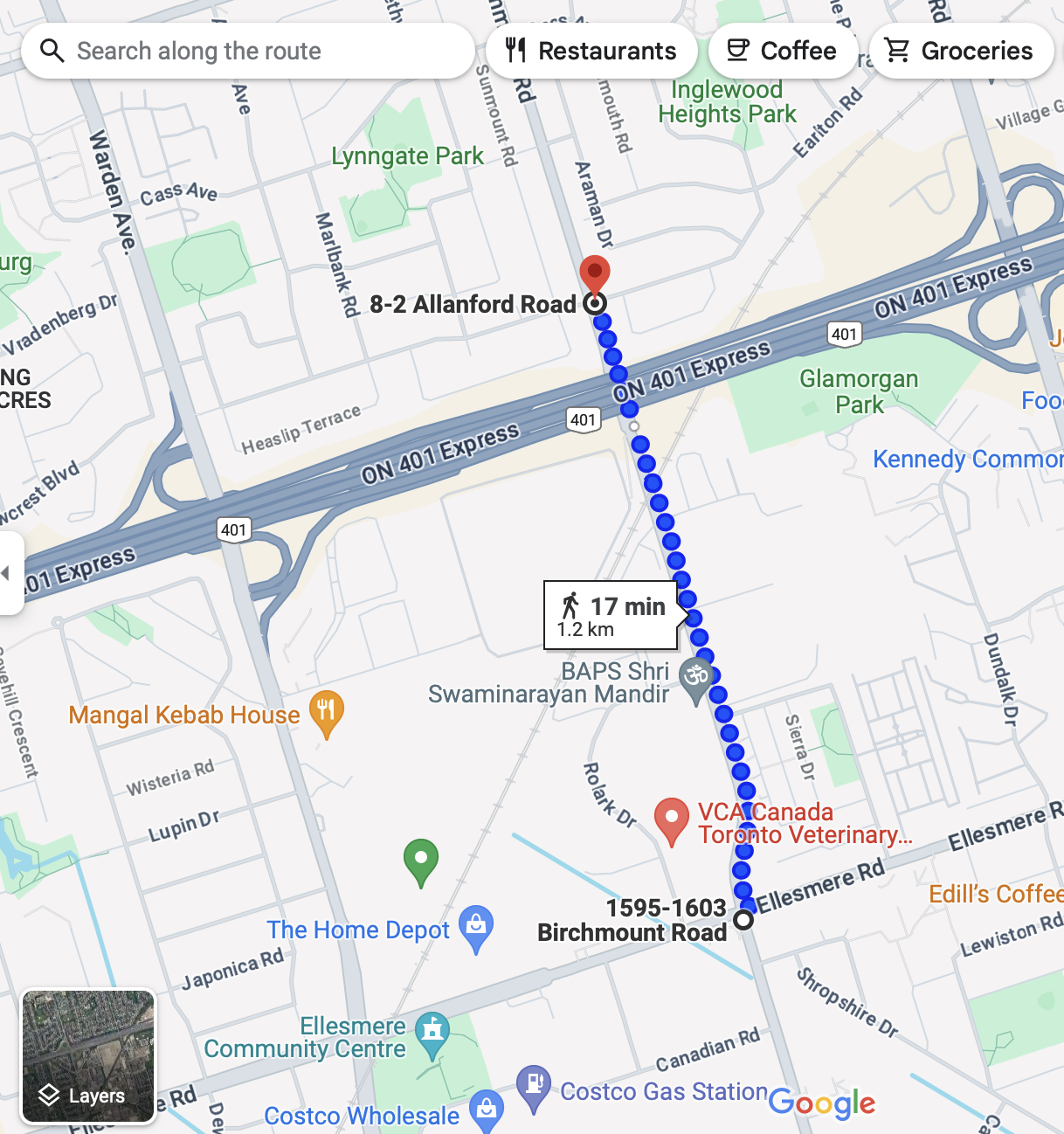
The longest stretch of road without a way for pedestrians to cross safely is along Warden Avenue between Ellesmere Road and Allanford Road. Any pedestrian walking north along Warden needs to walk 1.2 km and cross under Highway 401 to reach a signaled intersection. There were three pedestrian deaths in nine years, from 2009 to 2018, along this stretch of road.
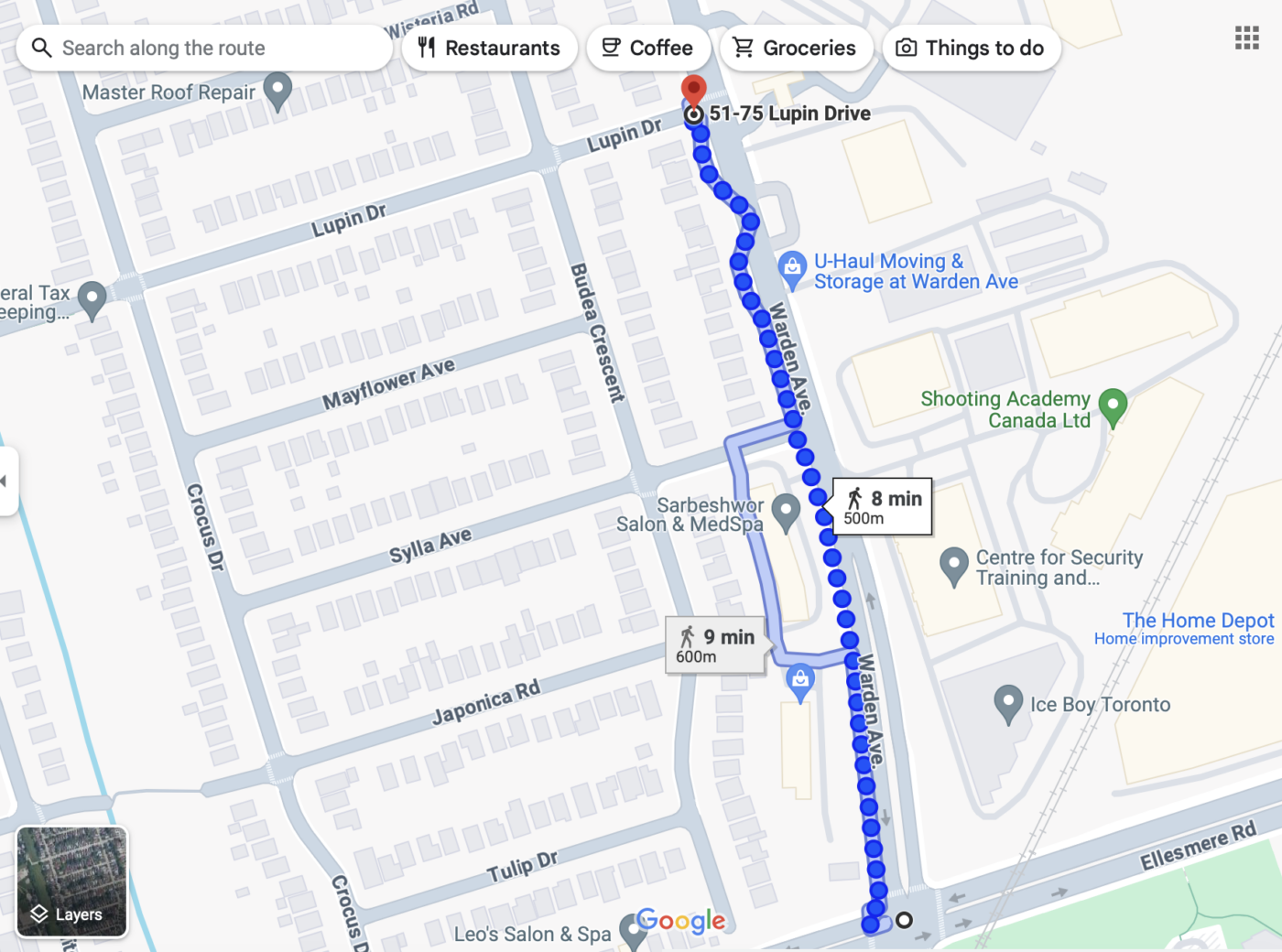
DISTANCE BETWEEN PROTECTED CROSSINGS FOR PEDESTRIANS TRAVELLING BETWEEN ELLESMERE ROAD AND ALLANFORD ROAD. 📸: GOOGLE MAPS SCREENSHOT. Another long stretch of road in Wexford/Maryvale without a mid-block crossing is along Warden Avenue between Ellesmere Road and Lupin Drive.DISTANCE BETWEEN PROTECTED CROSSINGS FOR PEDESTRIANS TRAVELLING BETWEEN WARDEN AVENUE AND LUPIN DRIVE. 📸: GOOGLE MAPS SCREENSHOT.
In 2017, a mother and daughter were hit by two cars while crossing the road from the Silver Spoon diner at Warden and Continental Place – halfway between the traffic lights at Warden Avenue and Ellesmere Road, and Warden Avenue and Lupin Drive.
The City of Toronto studied the intersection to see if a signaled light or pedestrian crosswalk was warranted, but ultimately deemed it unnecessary.
Six years later, in July 2023, a man in his fifties was killed attempting to cross the street at Warden and Continental when a drunk driver moving southbound struck him.
“I see a lot of times it happens that people got hit there [Warden and Continental], and almost got hit,” says Jon Lee, who works at Tekworks Automotive on the east side of Warden just south of Continental Place. “This is a very dangerous situation right now.…If they don’t look into it, someone might get killed in the future.”
For biking lawyer Shellnut, who’s dealt with countless clients harmed by drivers colliding with them while on foot or bicycle, the City isn’t doing enough to reach its stated target of achieving zero traffic-related deaths and serious injuries.
“People’s lives change forever where you [municipal government] could have made a simple choice to reduce speed or put some protective infrastructure in. It’s a no-brainer. It needs to get done,” he says.
Today’s stories lead to tomorrow’s solutions, so sign up for our newsletter to take action on the issues you learn about in The Green Line.
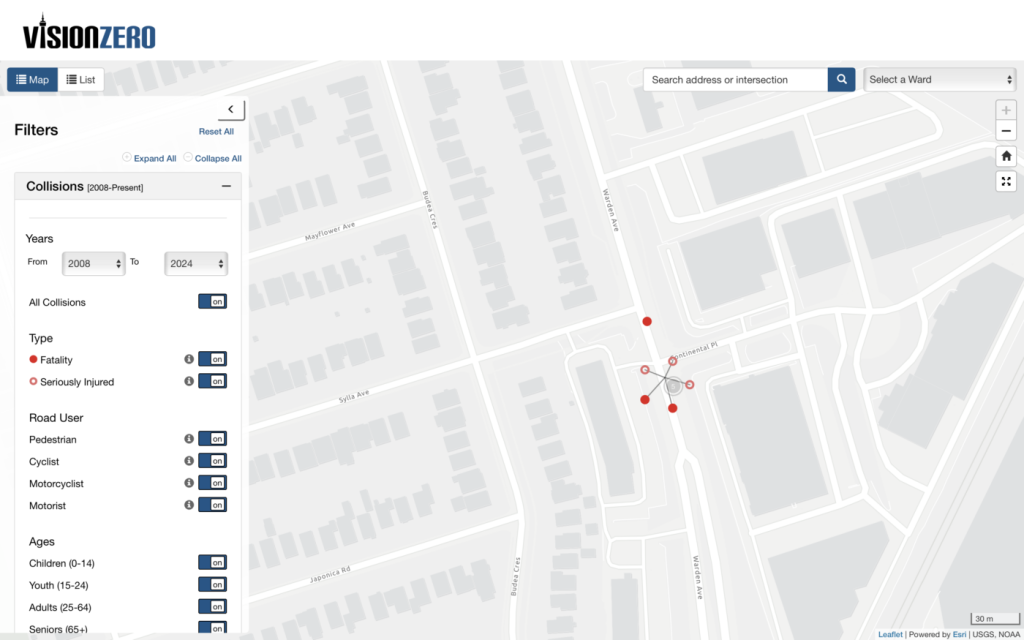
One intersection in the neighbourhood of Wexford/Maryvale illuminates the dangers facing pedestrians in Scarborough and the consequences of poor pedestrian-safety infrastructure — perhaps better than any other.
That intersection is Warden Avenue and Continental Drive, about 250 metres north of Ellesmere Road, where three pedestrians were killed in the span of six years. Another pedestrian was seriously injured there in 2015, along with two motorcyclists – one in 2016, one in 2019. A driver also died in 2019. That brings the total number of people killed or seriously injured at this intersection to seven since 2015, which is close to one per year.
Pedestrian safety is a problem not just in Wexford or Scarborough, but across Toronto.
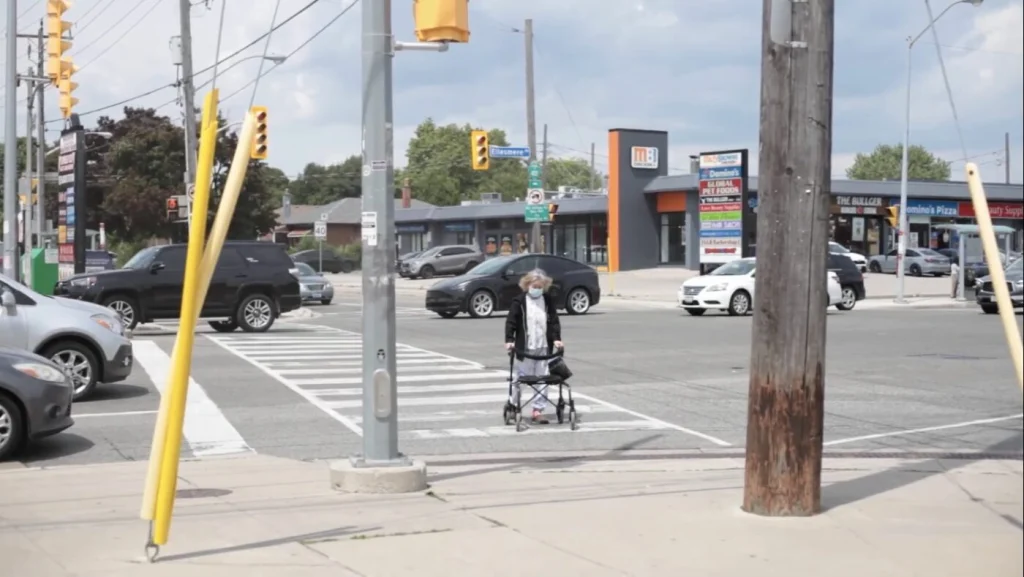
WATCH HOW LONG IT TAKES THIS PEDESTRIAN TO CROSS THE INTERSECTION SAFELY.
🎥 : ANTHONY LIPPA-HARDY/THE GREEN LINE.
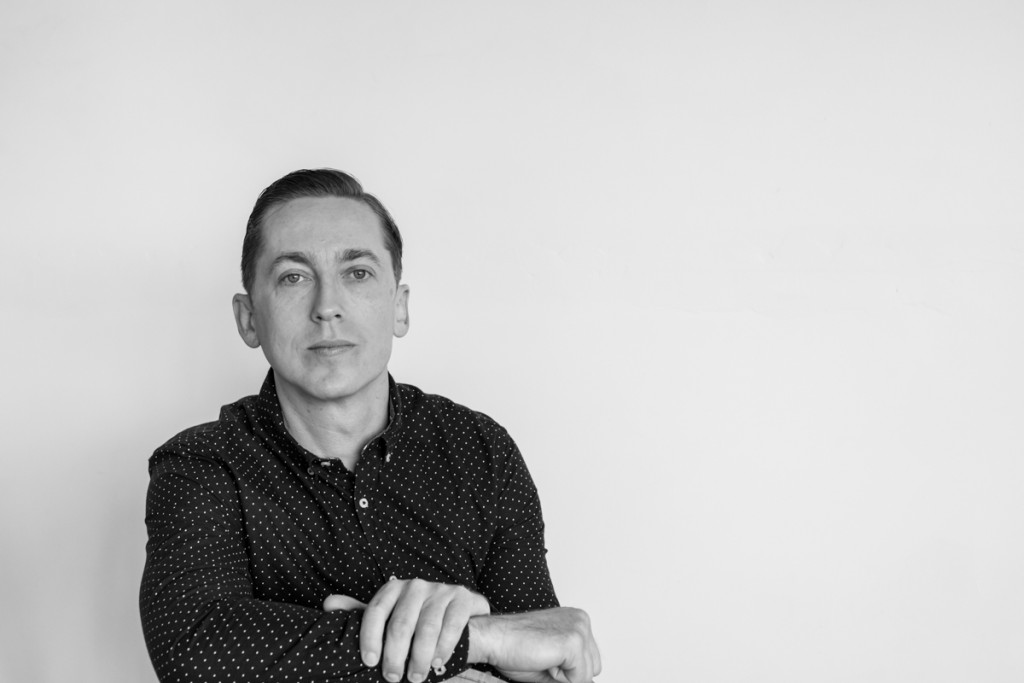
David Shellnutt, the self-described “the Biking Lawyer” who represents injured cyclists and pedestrians, believes numerous legislative and structural reforms are needed to improve pedestrian safety in Toronto.
“It’s crazy to me that you can get a license at 16, 17…and then not until you’re 80 will you ever have to undergo another test — that’s 60 years of infrastructure changes, [of] automobile changes,” he says. “When my mom got her license, they didn’t have bike lanes. Now when she comes to Toronto, there’s a bunch of them.”
“It’s unbelievable to me that we don’t have ongoing driver training in Ontario.”
Kaitlyn MacDonell, a partner at Howie, Sacks and Henry LLP, represents pedestrians injured by drivers in Toronto, which she describes as an “epidemic” in the city.
She says she’s traveled to cities such as Tokyo and London, and witnessed first-hand how pedestrian safety infrastructure is built fundamentally differently in those cities, compared to Toronto and other North American cities. MacDonell says that in Tokyo and London, pedestrians generally don’t cross at the intersection with vehicle traffic, but instead several feet away from the intersection at a crosswalk.
“Pedestrians cross at the designated crosswalk, rather than having traffic also being ushered through in the same time-sequence lights. It creates a safety mechanism for pedestrians to travel because…[the crosswalks are] not where [drivers] are turning right or left and not being able to see them,” says MacDonell.
These kinds of changes represent a potential long-term solution that would require a fundamental rethinking of how pedestrians and drivers interact in Toronto, as well as time to rebuild infrastructure if adopted.
Whether or not Toronto decides to embrace this model of keeping pedestrians away from intersections, experts say there’s a clear need for more protected crossings — be they signal lights or crosswalks — in neighbourhoods like Wexford.
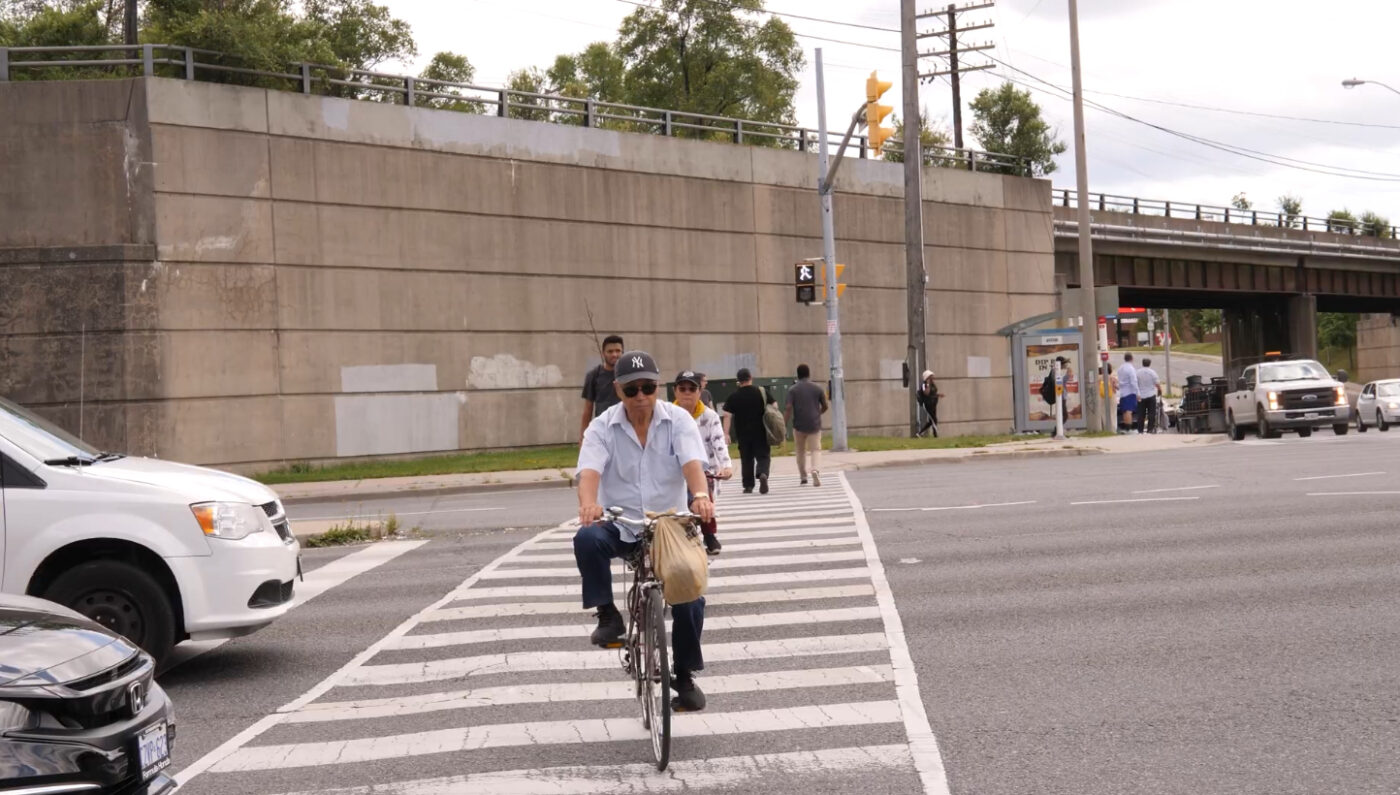
SEE HOW LONG IT TAKES TO REACH A PROTECTED CROSSING WHILE WALKING NORTH ALONG BIRCHMOUNT ROAD FROM LAWRENCE AVENUE.
🎥 : ANTHONY LIPPA-HARDY/THE GREEN LINE.
Another important factor in pedestrian safety is driver behaviour. Recently, legislative changes have been proposed in Ontario to deter driver collisions with pedestrians, and to improve safe driving behaviour.
Shellnutt supports the Moving Ontarians Safely Act because it would bring out harsher penalties for drivers. “We really support the provincial NDP and their push for the amendments to the Moving Ontarians Safely Act, which will bring out harsher penalties for people. We need to deter this kind of behaviour because right now…everybody knows you can get away with almost anything while you’re behind the wheel,” he says.
That bill, brought forward in Ontario last November, would’ve added harsher penalties on drivers who injure pedestrians, making them take driver re-education courses, perform community service related to driving safety and listen to victim impact-statements. It was voted down by the Progressive Conservative majority in Queen’s Park that same month.
Despite the City of Toronto’s efforts to achieve its vision of zero roadway-related deaths and serious injuries since the program began in 2016, both the municipal and provincial government need to do more to improve road safety, according to Shellnutt.
“Once a week, once a month, we see a seriously sick, seriously injured cyclist case get tossed for lack of resources or they settled for a lower charge or something like that….Then the [driver] gets a $110 ticket that they talked down to an even further slap on the wrist, he explains. “Unless you are absolutely intoxicated behind the wheel, and kill someone with real malice, you’re not going to really receive a punishment in Ontario. Looking down at your phone and running someone over, you’re going to get a careless driving charge and maybe — maybe — two years of driving probation.”
“The fact that you can kill someone in your car at any time, and basically get away with it with a slap on the wrist, says everything you need to know about driving in Ontario.”
Here’s your chance to support the only independent, hyperlocal news outlet dedicated to serving gen Zs, millennials and other underserved communities in Toronto. Donate now to support The Green Line.
WEXFORD BLOOMS 2GETHER: COMMUNITY VOICES FOR SAFER STREETS
A community meal and Story Circle hosted by The Green Line and plazaPOPS.
About the Event
Sunday
AUG. 25, 2024
1 p.m. to 4 p.m. ET
WexPOPS HUB SITE2020 Lawrence Ave. E.
RSVP
The Green Line is partnering with PlazaPOPS (for the third time!) and Temple University to host a community meal and Story Circle focused on pedestrian safety in Wexford/Maryvale. Attendees will get to gather over a catered meal to share their experiences as pedestrians who deal with the lack of local safety measures, then meet in small groups to generate community-led solutions.
They’ll also get the chance to join a Q&A with David Shellnutt, a.k.a. The Biking Lawyer, and learn about how they can advocate for themselves as pedestrians and cyclists. Food and drinks will be provided, and spaces are limited, so register before spots fill up. RSVP now for our free in-person event.
Events are an essential part of our Action Journey. We want to empower Torontonians to take action on the issues they learn about in The Green Line — so what better way to do that than by bringing people together? From community members to industry leaders, anyone in Toronto who’s invested in discussing and solving the problems explored in our features is invited to attend. All ages are welcome unless otherwise indicated. Our only guidelines? Be present. Listen. Be kind and courteous. Respect everyone’s privacy. Hate speech and bullying are absolutely not tolerated. At the end of the day, if you had fun and feel inspired after our events, then The Green Line team will have accomplished what we set out to do. Any questions?Contact Us.
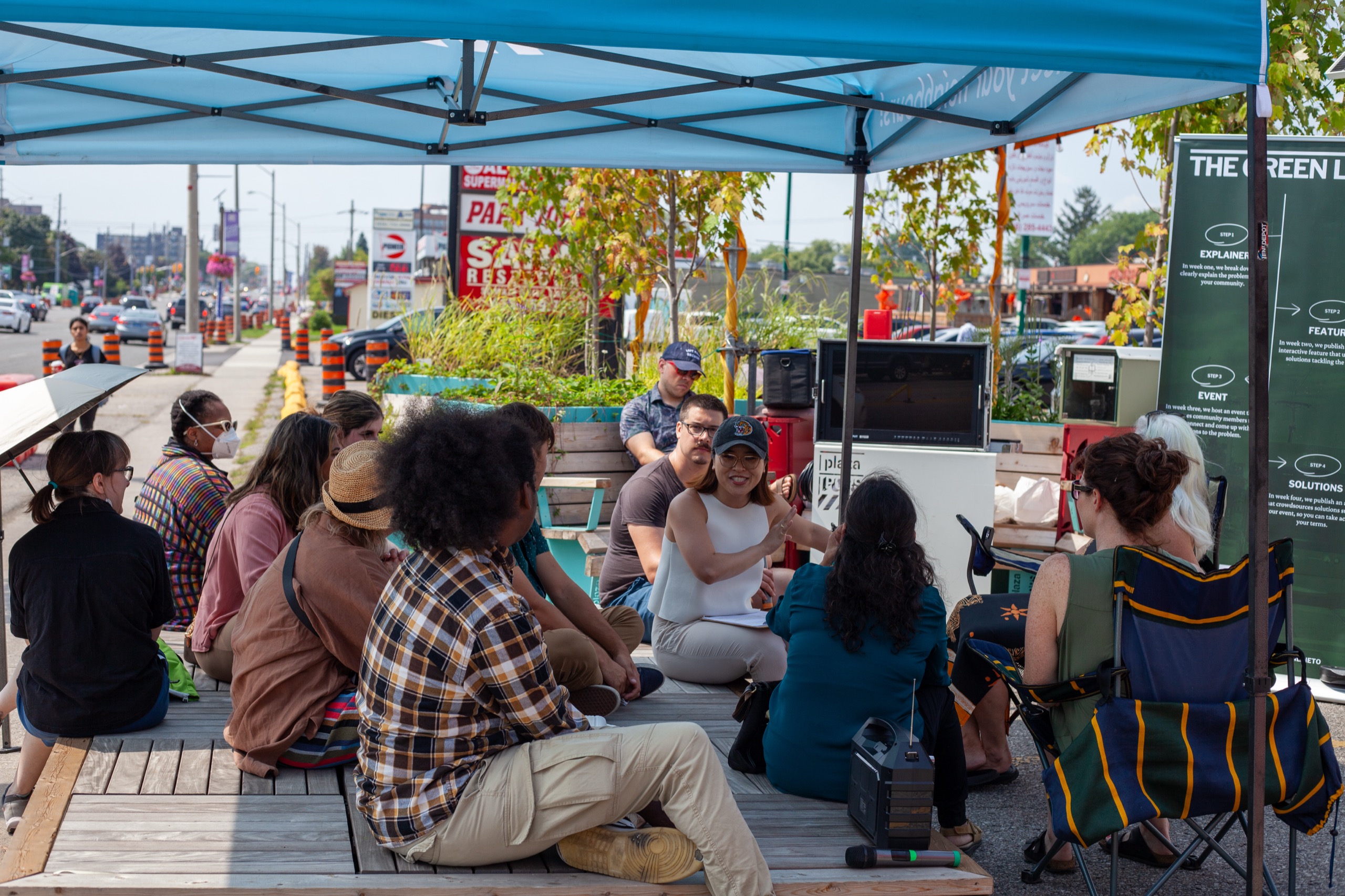
Event attendees at The Green Line’s August 2024 Action Journey about pedestrian safety share their stories of close calls with dangerous drivers in Wexford/Maryvale at the plazaPOPS hubsite on Sunday, Aug. 25, 2024.📸 Lillie Coussée/The Green Line.
Event Overview
See what you missed
from our latest event.
Our community members brainstormed solutions for improving pedestrian safety in Wexford/Maryvale.
Compiled by James Westman.
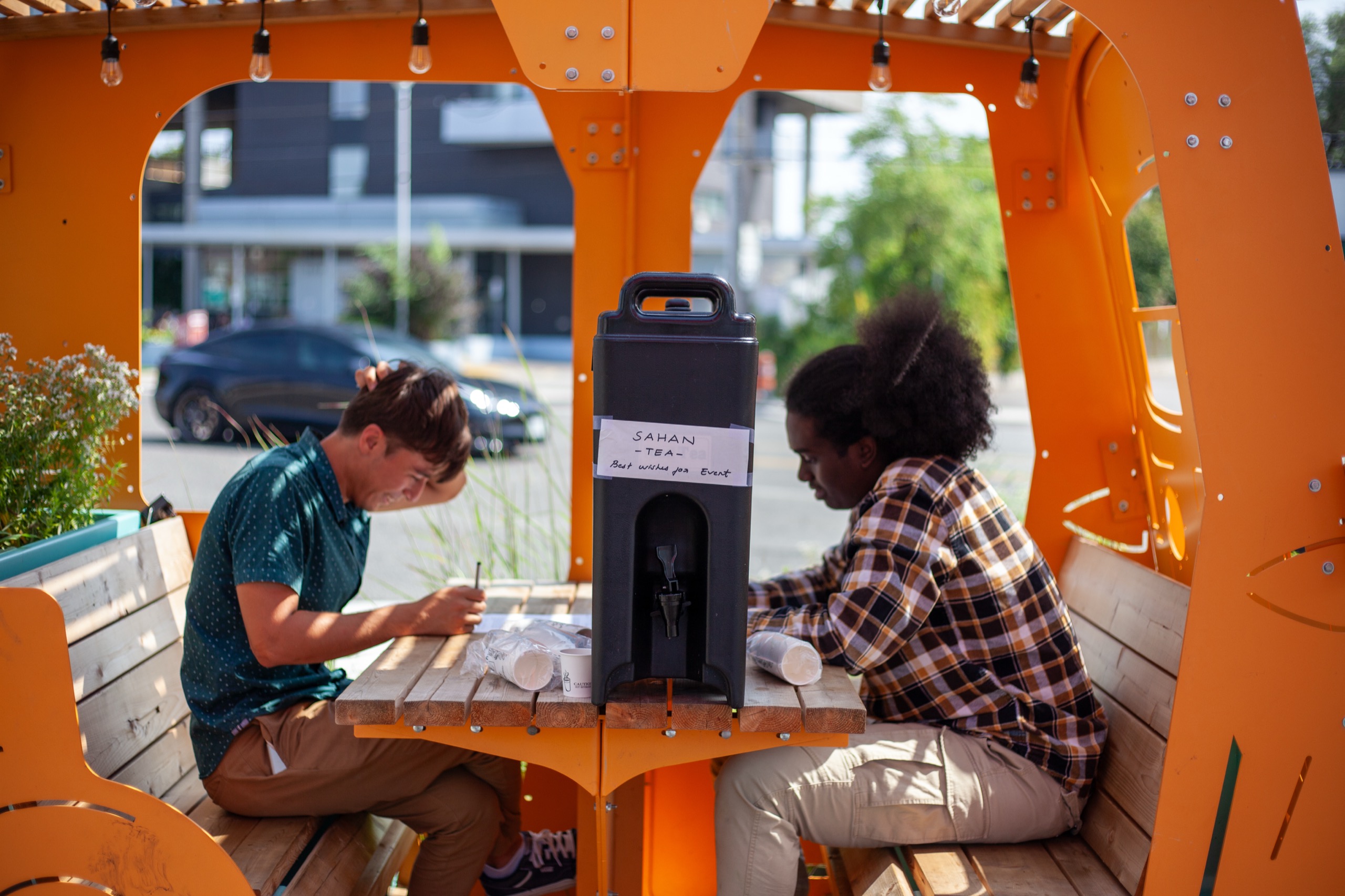
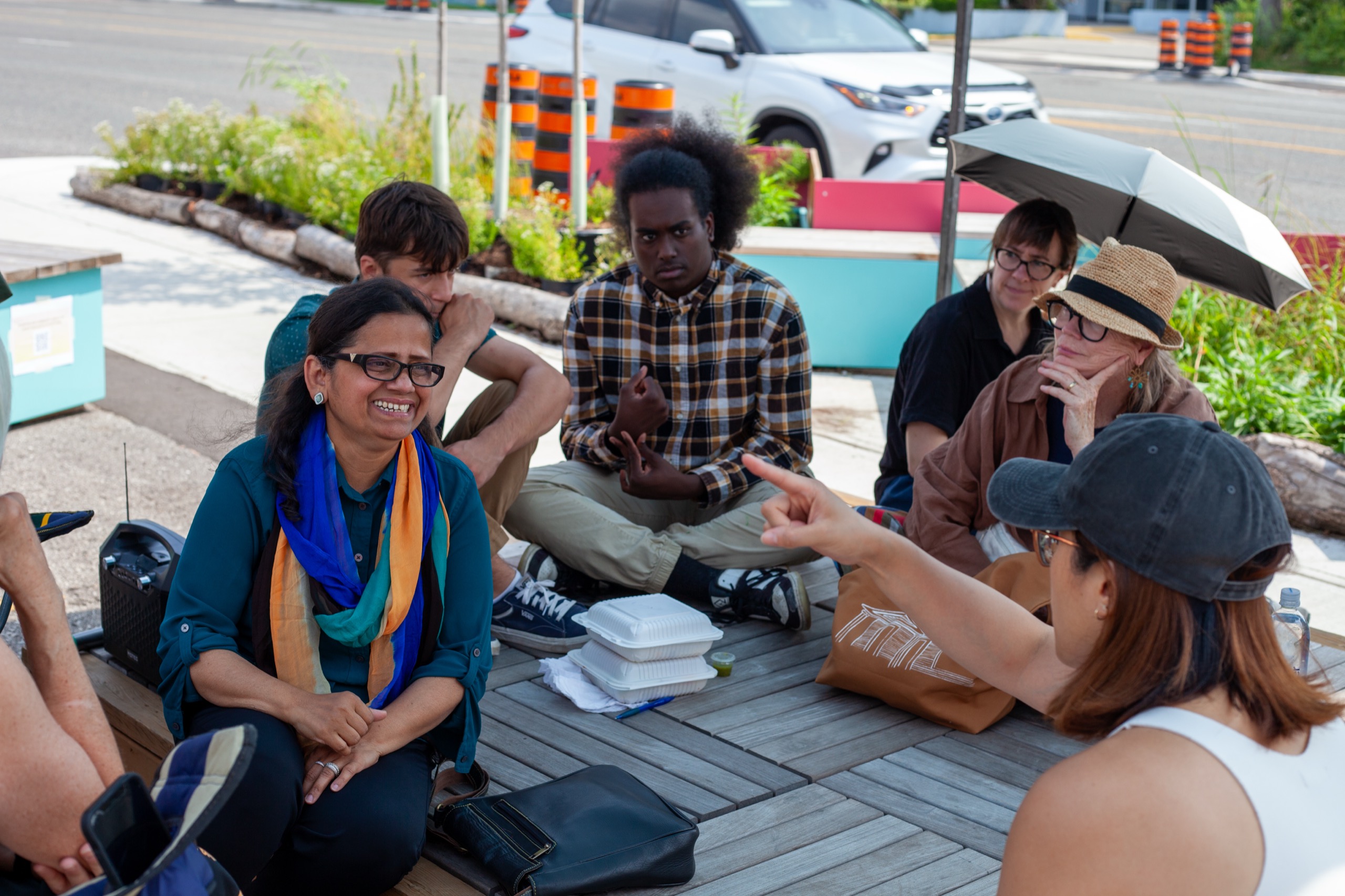
David Shellnutt, a.k.a. The Biking Lawyer, answers a question about how Toronto can improve pedestrian and cycling safety infrastructure. 📸: Lillie Coussée/The Green Line.ATTENDEE JULIA KEECH TALKS ABOUT WHY SHE FEELS LAWRENCE AVENUE EAST AND WARDEN AVENUE IS A DANGEROUS INTERSECTION TO WALK THROUGH. 📸: Lillie Coussée/The Green Line.ATTENDEES SYED HATIM SHAH AND MOHAMED ABDU FILL OUT The Green Line's community SURVEYS to describe THEIR experiences as pedestrians and cyclists in Wexford/Maryvale. 📸: Lillie Coussée/The Green Line.
SOLUTIONS
SLOW DOWN DRIVERS
The most common solution that event attendees raised was that drivers in Wexford/Maryvale need to slow down. There are countless ways the City of Toronto can do this: reducing 60 kph zones, such as along Lawrence Avenue, to 50 kph; reducing the city-wide standard of 50 kph to 40 kph and reducing 40 kph community safety zones to 30 kph. Other ways to slow down drivers include: automated speed enforcement cameras, speed bumps and bollards. “We have a culture of speed, so we need to create the infrastructure that kind of forces people to respect others on the road and actively encourages us, and enforces us, to slow down,” says Lee Scott.
NO RIGHT ON REDS
Many of the event attendees felt that turning right on red lights needed to be banned at problem intersections in Wexford/Maryvale and in Toronto at large (it’s a policy Quebec has implemented on the island of Montreal). Ismat Ara, who crosses Warden Avenue and Lawrence Avenue East every day, says most drivers turning right at this intersection aren’t paying attention to pedestrians so she has to raise her hand as she crosses to get them to notice her.
COMPLETE STREETS
Event attendees felt that, in addition to safety concerns, Wexford/Maryvale’s streets should be more accessible and enjoyable for pedestrians. Mohamed Abdu says planting trees along sidewalks and adding benches to sit in the shade would make a positive difference during long walks between intersections. Other suggestions from attendees included narrowing streets so pedestrians don’t have to cross as many lanes, and adding more medians and boulevards for pedestrians to enjoy green spaces.
ACTIONS
Do something about the problems that
impact you and your communities.
Request a Speed Bump
The City of Toronto allows locals to make requests for traffic-calming measures, such as speed bumps.
The City of Toronto allows locals to make requests for investigations into new or existing pedestrian crossings, as well as safety investigations at intersections.
Attendees discuss pedestrian safety in Wexford/Maryvale during a Story Circle. 📸: Lillie Coussée/The Green Line. Supporting The Green Line means supporting Toronto. Join our membership program today, so you can redefine our city as you see it.
The Green Line uses cookies so the site works, to remember your reading progress, and (with your consent) to understand which stories resonate. You can accept all, reject everything non-essential, or pick what you’re comfortable with. Privacy policy
Welcome back👋
New here or returning? Same flow. Drop your email — we'll handle the rest.



Join the conversation